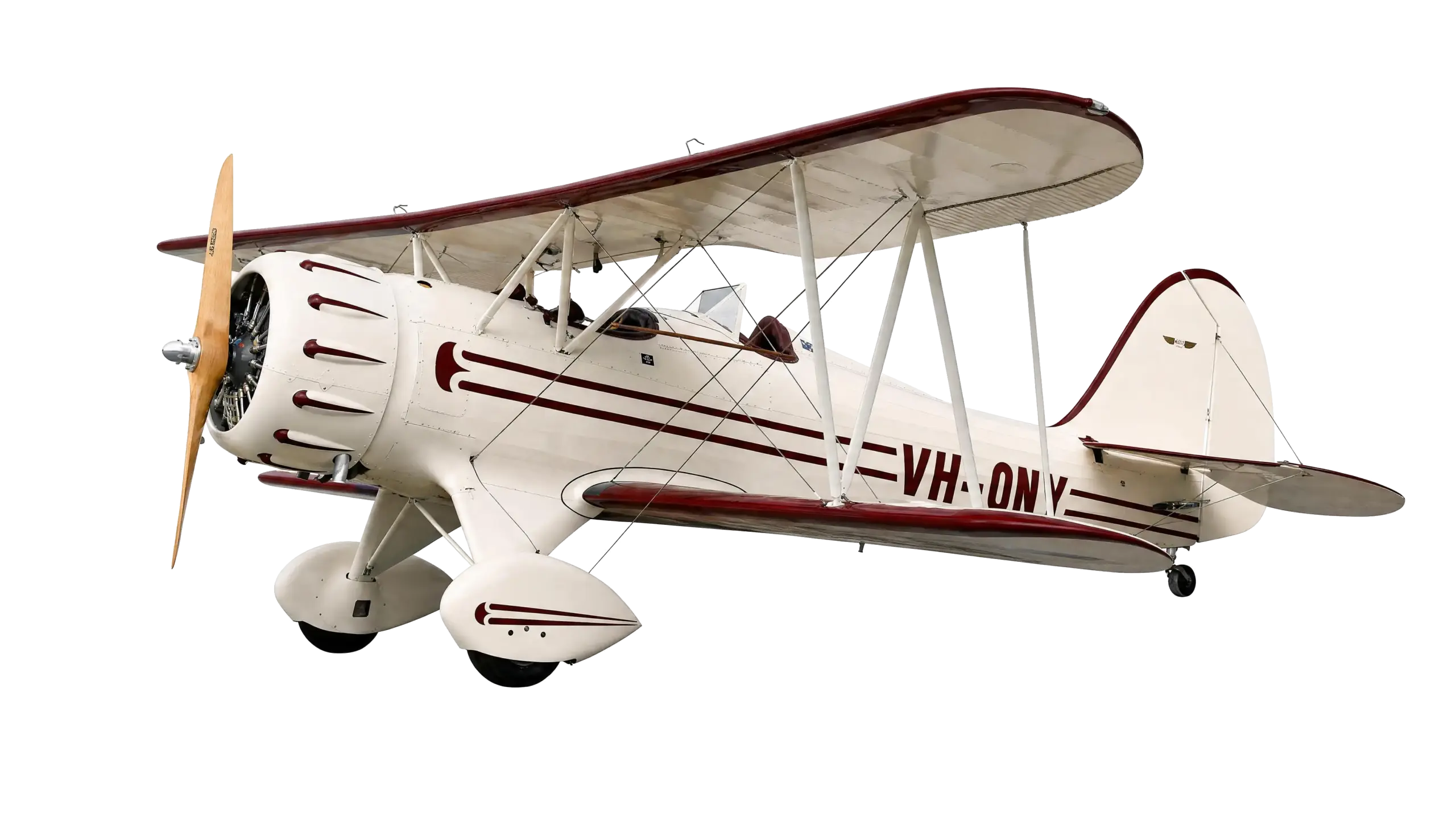
WACO YMF-5
Aircraft Collection
The WACO YMF-5 is open-cockpit flying in its purest American form:
a hand-built radial-engine biplane where the structure, the sound, and the experience are impossible to separate.
Overview
The WACO YMF-5 is not a nostalgic imitation of early American aviation.
It is a continuation of it. Its welded steel-tube fuselage, fabric-covered wings, exposed radial engine,
tandem open cockpits, interplane struts, flying wires, and tailwheel stance preserve the visual language
of the Golden Age while remaining a serious, capable flying machine.
Few aircraft make their construction so visible. The pilot does not sit inside an anonymous cabin.
The pilot sits between wings, wires, fabric, wood, metal, wind, and the deep mechanical rhythm
of a radial engine turning directly ahead.
That honesty is what gives the YMF-5 its appeal. It is not designed around speed, automation,
or efficiency alone. It is designed around the feeling of flying as a physical craft.
Operational Use
The original WACO family earned its reputation through sport flying, personal travel, training,
airshows, barnstorming, and the fast-growing American private-aviation culture of the 1920s and 1930s.
These were aircraft built for pilots who wanted to feel connected to the machine rather than separated from it.
The modern YMF-5 continues that role as a sport, touring, and flightseeing aircraft. It is equally at home
arriving at a grass field, flying a scenic route over open country, or becoming the center of attention
at a vintage aviation event.
Historical Context
WACO was one of the defining American aircraft manufacturers of the Golden Age of Aviation.
The company built a broad range of sport, training, business, and military-related aircraft,
but its open-cockpit biplanes became the machines most strongly associated with the romance
and confidence of prewar American flying.
The YMF appeared in 1934 as part of the Model F family. Decades later, the design returned through
modern certified production, preserving its classic outline while introducing updated materials,
systems, braking, safety equipment, and modern avionics options.
Model Focus
This project is conceived as a faithful flying reproduction of the original airframe,
not a simplified decorative biplane. The staggered wings, cabane struts, interplane struts,
wire-braced structure, radial-engine nose, dual open cockpits, tailwheel geometry, and fabric-covered surfaces
are treated as essential elements of the aircraft’s identity.
The model is developed around full functional mechanization of the airframe wherever
the original structure makes it meaningful: working ailerons, elevator and rudder, mechanically credible
tailwheel steering, scale flap behavior where selected, realistic wing bracing, and accurately proportioned
control-linkage details.
In advanced configurations, the onboard controller can support a WACO-specific flight profile:
smooth radial-style throttle response, measured power transitions, lighting sequences, and a calm,
deliberate rhythm that fits a large open-cockpit biplane rather than a generic electric platform.
Custom Finish
Every WACO deserves a finish with its own personality. A custom-built model can be developed around
period-correct colors, vintage registration markings, hand-painted pinstriping, leather-style cockpit treatment,
wheel-pant details, fabric texture, and personalized red-and-white schemes that reinforce the aircraft’s
unmistakably American presence.
The goal is not simply to recreate a classic silhouette. It is to create a
specific, individually finished aircraft with the character of a real owner-flown biplane:
polished where it should be polished, weathered where it should be used, and finished with enough detail
to make the aircraft feel alive before it ever leaves the ground.
The WACO YMF-5 should feel handcrafted because the original was handcrafted.
Its scale character comes from visible structure, open-cockpit presence, radial-engine rhythm, and the honest mechanics of a true American biplane.
Wronsky Aeroworks Model
Every Wronsky Aeroworks model is individually finished by hand, receives its own serial number, and undergoes detailed quality inspection before shipment. Each aircraft is produced in limited numbers with an emphasis on historical accuracy, clean geometry, crisp surface detail, and premium presentation.