North American P-51D Mustang
Aircraft Collection
The North American P-51D Mustang became one of the defining American fighters of World War II:
fast, long-ranged, cleanly engineered, and capable of carrying the air war far beyond the limits of earlier escort aircraft.
Overview
The P-51D Mustang was the aircraft that brought together range, speed, altitude performance,
and maneuverability in a way few piston-engine fighters ever managed. Its long nose, laminar-flow wing,
bubble canopy, deep radiator intake, and narrow landing gear created one of the most recognizable silhouettes
in American military aviation.
The Mustang did not begin life as the definitive long-range escort fighter. That role emerged when the airframe
was paired with the Packard-built Merlin engine. The result was an aircraft with the high-altitude performance
needed to accompany heavy bombers deep into occupied Europe while still retaining the fuel capacity to return.
The P-51D was the mature version of the concept. Its bubble canopy improved visibility, six .50 caliber Browning
machine guns gave it substantial firepower, and its clean aerodynamic shape allowed the aircraft to remain fast,
efficient, and dangerous across long distances.
Operational Use
The Mustang became central to the USAAF escort campaign over Europe. By accompanying bomber formations farther
into German airspace, P-51 units helped reduce the Luftwaffe’s ability to attack Allied heavy bombers without
facing capable fighter opposition.
The aircraft also served as a fighter-bomber, reconnaissance platform, ground-attack aircraft, and armed escort
in the Mediterranean, Pacific, and later Korean War theaters. Bomb racks, rockets, long-range drop tanks,
and powerful machine-gun armament made the Mustang adaptable well beyond pure air-to-air combat.
Its greatest strength was not one isolated number on a specification sheet. It was the ability to fly far,
arrive with performance still available, fight effectively, and get home again.
Historical Context
The Mustang was developed at exceptional speed after North American Aviation was asked to produce fighters
for Britain. The original Allison-powered versions were effective at lower altitude, but the Merlin-powered
B, C, and D models transformed the aircraft into a high-altitude fighter with extraordinary range.
The P-51D became the best-known version of the family. It carried the iconic teardrop canopy, revised rear fuselage,
six-gun armament, and the visual balance that most people now associate with the word Mustang.
After the war, surviving aircraft continued in military service, racing, airshow flying, and restoration work,
ensuring that the type never disappeared from public memory.
Notable Pilots
The P-51 is associated with pilots including Chuck Yeager, Clarence “Bud” Anderson,
Don Gentile, George Preddy, and the pilots of the
332nd Fighter Group, later remembered as the Tuskegee Airmen.
These aircraft provide powerful starting points for historically grounded custom builds:
polished invasion stripes, olive drab anti-glare panels, squadron colors, nose art, tactical codes,
checkerboard markings, red tail assemblies, weathered metal finishes, exhaust staining, and the hard-used
appearance of fighters operating from wartime European airfields.
Model Focus
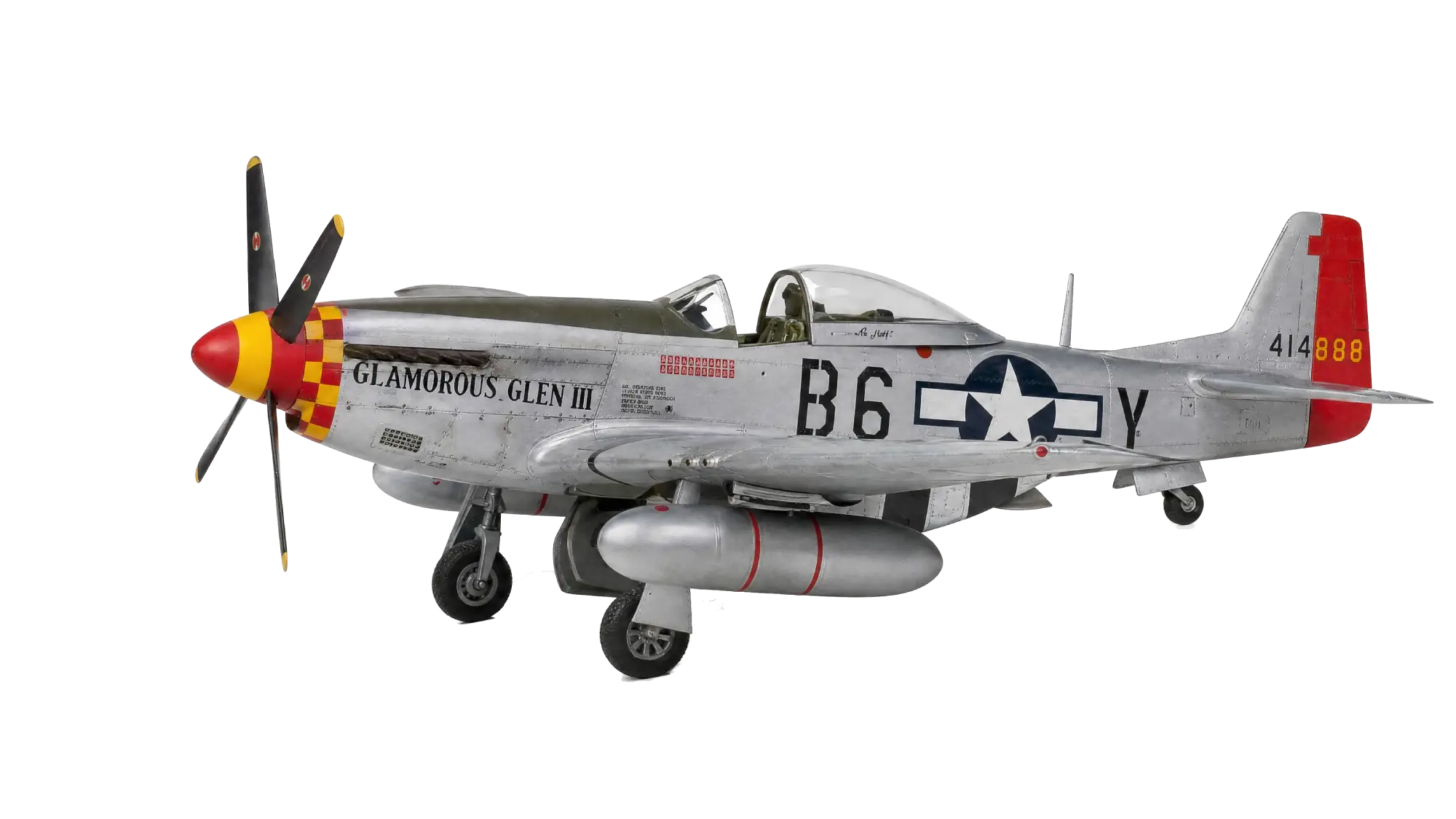
This project is developed as a faithful flying reproduction of the original airframe,
not a generic American fighter silhouette. The long Merlin nose, four-bladed propeller, laminar-flow wing,
radiator scoop, bubble canopy, tail profile, narrow retractable landing gear, and detailed gun-panel geometry
are treated as essential parts of the Mustang’s engineering identity.
The model is designed around full functional mechanization of the airframe wherever the
original structure makes it meaningful: working control surfaces, retractable landing gear, scale flap operation,
mechanically credible gear doors, radiator detail, tailwheel movement, and carefully proportioned control-surface behavior.
In advanced configurations, the onboard controller can support a Mustang-specific flight profile:
progressive throttle response, deliberate takeoff-power management, synchronized flap and landing-gear sequences,
lighting functions, and scale timing tuned to the character of a long-range Merlin-powered escort fighter.
Custom Finish
Every P-51D can become a custom-finished individual aircraft. A build may be based on a documented
pilot, squadron, theater, tactical code, nose art arrangement, invasion-stripe configuration, natural-metal finish,
camouflage pattern, weathering profile, or a restoration-inspired civilian warbird scheme.
The objective is not a generic silver Mustang. It is a historically credible individual aircraft
with custom surface depth, specific visual identity, and finishing quality that match the precision of a fully mechanized scale airframe.
The P-51D should look fast before the propeller begins to turn.
Its scale character comes from the long Merlin nose, clean wing geometry, visible mechanics, and the unmistakable confidence of America’s long-range escort fighter.
Wronsky Aeroworks Model
Every Wronsky Aeroworks model is individually finished by hand, receives its own serial number, and undergoes detailed quality inspection before shipment. Each aircraft is produced in limited numbers with an emphasis on historical accuracy, clean geometry, crisp surface detail, and premium presentation.