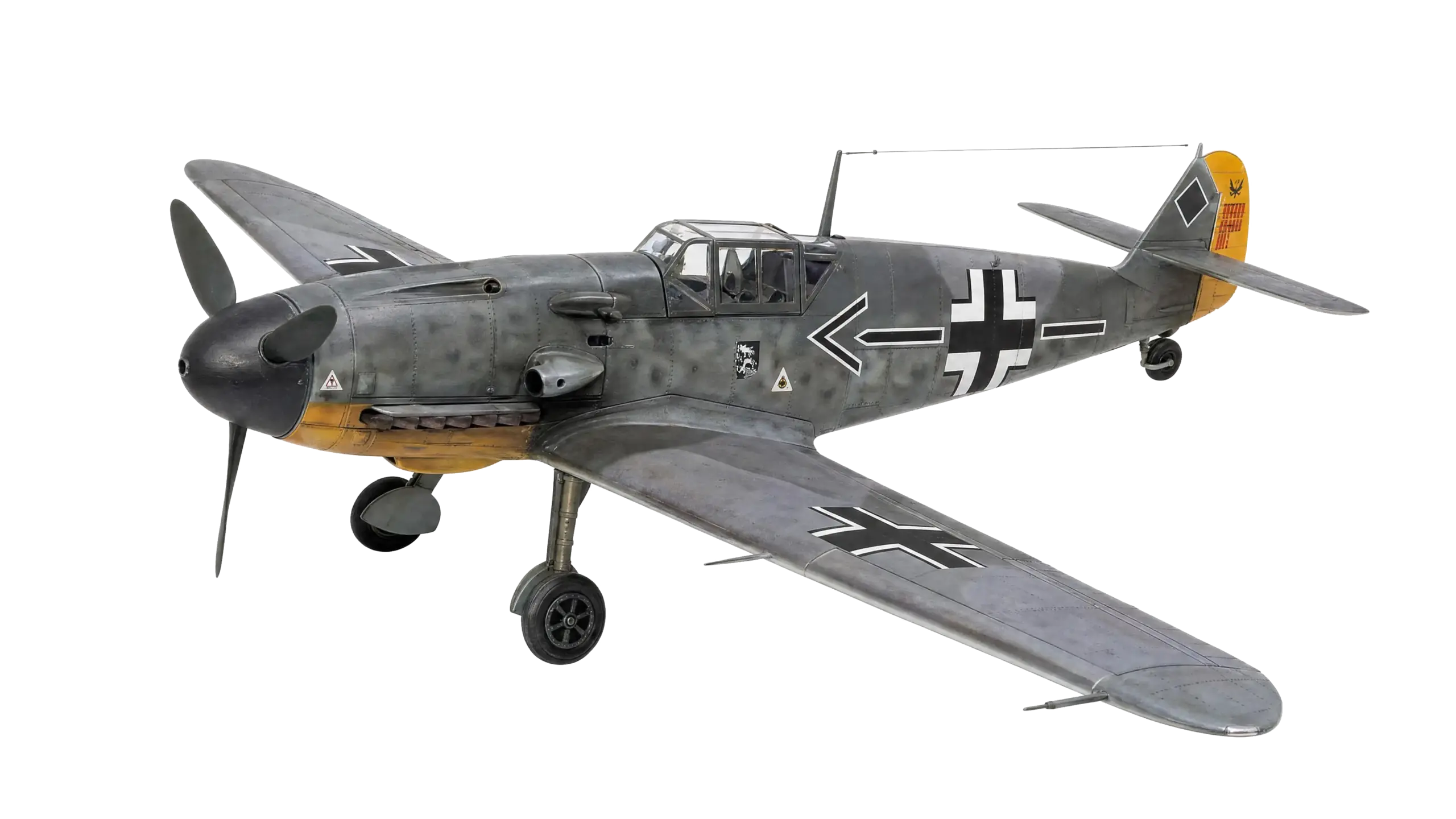
Messerschmitt Bf 109 F-4
Aircraft Collection
The Messerschmitt Bf 109 F-4 was the Friedrich at its sharpest:
a compact fighter refined around speed, clean aerodynamics, and a fuel-injected V-12 engine.
Overview
The Bf 109 F, known as the Friedrich, was more than a routine
update of the famous German fighter. It was a substantial aerodynamic refinement: a reshaped
nose, revised cooling system, cleaner wing, streamlined tail, and a more unified relationship
between the spinner, engine cowling, fuselage, and propeller.
The result was a fighter with an unusually compact visual rhythm. Everything appeared to be
pulled tight around the airframe’s centerline. The narrow fuselage, low wing, tapered tail,
large spinner, and close-set landing gear gave the aircraft its unmistakable stance.
It was a demanding machine on the ground, particularly during takeoff and landing. In the air,
however, the Bf 109 F combined acceleration, climb, and precision into a design widely regarded
as one of the most balanced versions of the Bf 109 family.
Operational Use
The Bf 109 F entered major front-line service in 1941 and operated over the English Channel,
the Eastern Front, the Mediterranean, and North Africa. It served in interceptor, escort,
combat air patrol, and tactical fighter roles.
Its fuel-injected DB 601 engine was an important part of its operational character. Unlike
many early carbureted engines, it could maintain fuel delivery during negative-G maneuvering.
That did not make the aircraft easy to fly, but it gave its engine response a distinct tactical
advantage in certain transitions and diving maneuvers.
Historical Context
The Bf 109 was a principal fighter of Nazi Germany’s Luftwaffe during World War II. The F-series
emerged after combat experience with earlier variants revealed the need for better streamlining,
revised cooling, and improved overall balance.
The F-4 introduced the 20 mm MG 151/20 cannon firing through the propeller hub. This centerline
armament arrangement is one of the details that defines the Friedrich’s nose profile and makes
the spinner, cowling, and engine installation visually inseparable.
Notable Pilots
The Bf 109 family is associated with pilots including Werner Mölders,
Adolf Galland, Hans-Joachim Marseille, and
Erich Hartmann. They flew different Bf 109 variants on different fronts,
but the aircraft became central to the Luftwaffe’s fighter force.
For an F-series custom build, Marseille’s Bf 109 F-4/Trop aircraft in North Africa provides
a particularly strong visual reference: desert filtration, theater camouflage, personal markings,
worn paint, dust, exhaust traces, and the hard operational look of an aircraft used far from
factory conditions.
Model Focus
This project is intended as a faithful flying reproduction of the original airframe,
not a generic warbird profile. The slim fuselage, spinner shape, close engine cowling, radiator
geometry, tailplane profile, narrow landing gear, and low-mounted wing are treated as structural
features of the real aircraft.
The model is designed around full functional mechanization of the airframe where
it matters: working control surfaces, retractable main gear, scale flap movement, radiator detail,
and optional leading-edge slat behavior in advanced custom configurations.
A pre-programmed onboard controller can support a Bf 109-specific response profile: deliberate
power transitions, synchronized gear and flap sequences, and scale-function timing that gives the
model the rhythm of a compact, fuel-injected fighter rather than a generic electric platform.
Custom Finish
Every Bf 109 can be developed as a specific historical aircraft rather than a factory-default
silhouette. Custom finishing may include a documented unit scheme, tactical number, theater
camouflage, personal markings, paint fading, field repairs, weathering, and operational staining.
The goal is a credible individual aircraft: one that reflects a real period,
a real visual language, and a level of surface detail worthy of a fully mechanized scale airframe.
The Bf 109 F should look engineered, not merely painted.
Its identity lives in the stance, the mechanism, the engine installation, and the disciplined tension of its compact design.
Wronsky Aeroworks Model
Every Wronsky Aeroworks model is individually finished by hand, receives its own serial number, and undergoes detailed quality inspection before shipment. Each aircraft is produced in limited numbers with an emphasis on historical accuracy, clean geometry, crisp surface detail, and premium presentation.