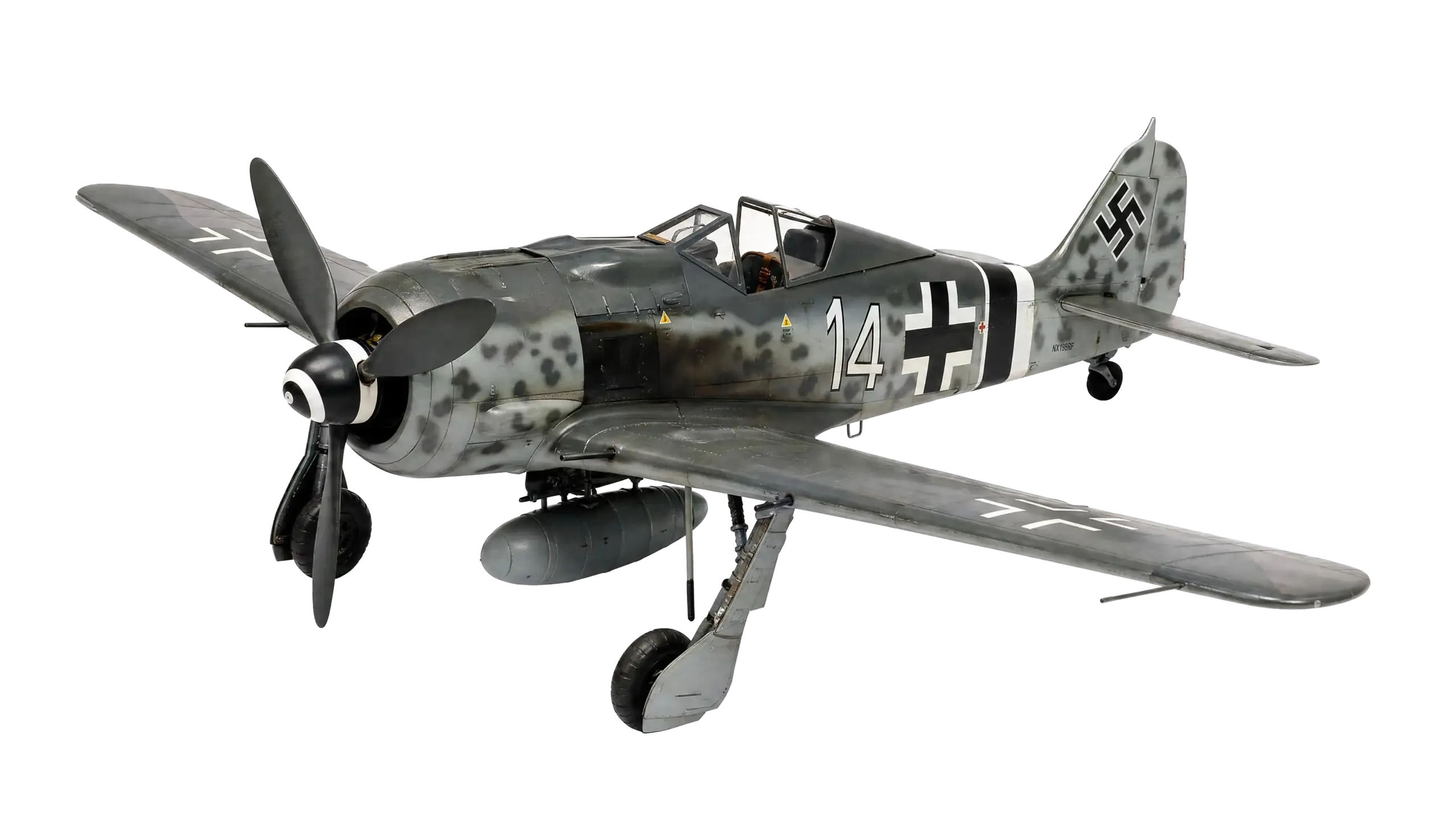
Focke-Wulf Fw 190 A-4
Aircraft Collection
The Focke-Wulf Fw 190 A-4 was one of the most formidable radial-engine fighters of World War II:
brutally compact, heavily armed, and engineered for aggressive performance.
Overview
The Fw 190 A was conceived as a powerful alternative to the Bf 109 and quickly earned a reputation
for strength, roll rate, firepower, and combat toughness. Where the Bf 109 looked narrow and tightly drawn around
its inline engine, the Fw 190 felt broader, heavier, and more physically aggressive thanks to its large radial engine
and wide-track landing gear.
The aircraft’s identity came from balance. Its short fuselage, broad wing roots, circular engine cowling, heavy armament,
and compact canopy created a fighter that looked muscular even when standing still. In the air, it delivered excellent
acceleration, strong low-to-medium altitude performance, and a roll response that made it extremely dangerous in combat.
The A-4 sits in the early mature phase of the Fw 190 story. It preserved the raw, purposeful character of the original
design while refining equipment, armament, and operational capability in a way that made the type truly front-line dominant.
Operational Use
The Fw 190 A served as a fighter, interceptor, bomber escort, ground-attack platform, and fighter-bomber.
It operated over Western Europe, the Eastern Front, and later in Reich defense roles, where its firepower and ruggedness
made it highly effective against both air and ground targets.
One of its great practical strengths was its wide-track landing gear, which made ground handling more forgiving
than the Bf 109. That mattered in real operations. Combined with a robust radial engine and heavy armament,
the Fw 190 gained a reputation as a brutally effective combat machine that could absorb punishment and still remain dangerous.
Historical Context
First flown in 1939, the Fw 190 was designed by Kurt Tank and entered service in 1941.
It shocked Allied pilots when it appeared over the Channel Front, where its speed, climb, acceleration, and especially roll rate
made it one of the most feared German fighters of the war.
The radial-engine layout distinguished it visually and mechanically from its Luftwaffe stablemate, the Bf 109.
The Fw 190’s engine installation, cooling arrangement, stubby fuselage proportions, and heavy nose gave it a visual character
that still feels uniquely mechanical and brutally honest.
Notable Pilots
The Fw 190 is associated with pilots such as Josef Priller, Otto Kittel,
Walter Nowotny, and Heinz Bär. Their operational histories covered different theaters
and different versions of the aircraft, but the type became inseparable from the Luftwaffe’s most effective fighter operations.
For custom-built aircraft, Priller’s Fw 190s and Eastern Front machines flown by Otto Kittel offer especially strong reference points:
distinctive tactical markings, unit colors, weathering, field wear, and individual visual identity rather than anonymous factory finish.
Model Focus
This project is developed as a faithful flying reproduction of the original airframe, not just a generic WWII fighter shell.
The radial engine nose, broad landing gear stance, low wing geometry, canopy profile, armament line, cooling openings,
and tail proportions are treated as essential parts of the aircraft’s engineering identity.
The model is designed around full functional mechanization of the airframe wherever the real aircraft demands it:
moving control surfaces, retractable landing gear, scale flap movement, mechanically credible gear doors, and structural details
that preserve the Fw 190’s compact but forceful character.
In advanced configurations, the onboard control module can coordinate gear cycles, flap deployment, lighting, and scale timing
in a way that supports the aircraft’s distinct operational rhythm. The point is not simply to make it fly,
but to make it behave like a serious scale interpretation of a heavily armed German fighter.
Custom Finish
Every Fw 190 benefits from a custom-finished identity. That may include a documented unit scheme,
tactical numbers, theater camouflage, cowling markings, paint wear, operational staining, winter or field-applied finishes,
and other details that turn the aircraft into a specific historical machine rather than a generic warbird.
The goal is always the same: a historically credible, individually finished aircraft with visual weight,
surface depth, and finishing quality that match the precision of a fully mechanized scale airframe.
The Fw 190 should feel as formidable on the ground as it does in the air.
Its scale character comes from the stance, the radial-engine presence, the mechanism, and the disciplined aggression of the original design.
Wronsky Aeroworks Model
Every Wronsky Aeroworks model is individually finished by hand, receives its own serial number, and undergoes detailed quality inspection before shipment. Each aircraft is produced in limited numbers with an emphasis on historical accuracy, clean geometry, crisp surface detail, and premium presentation.