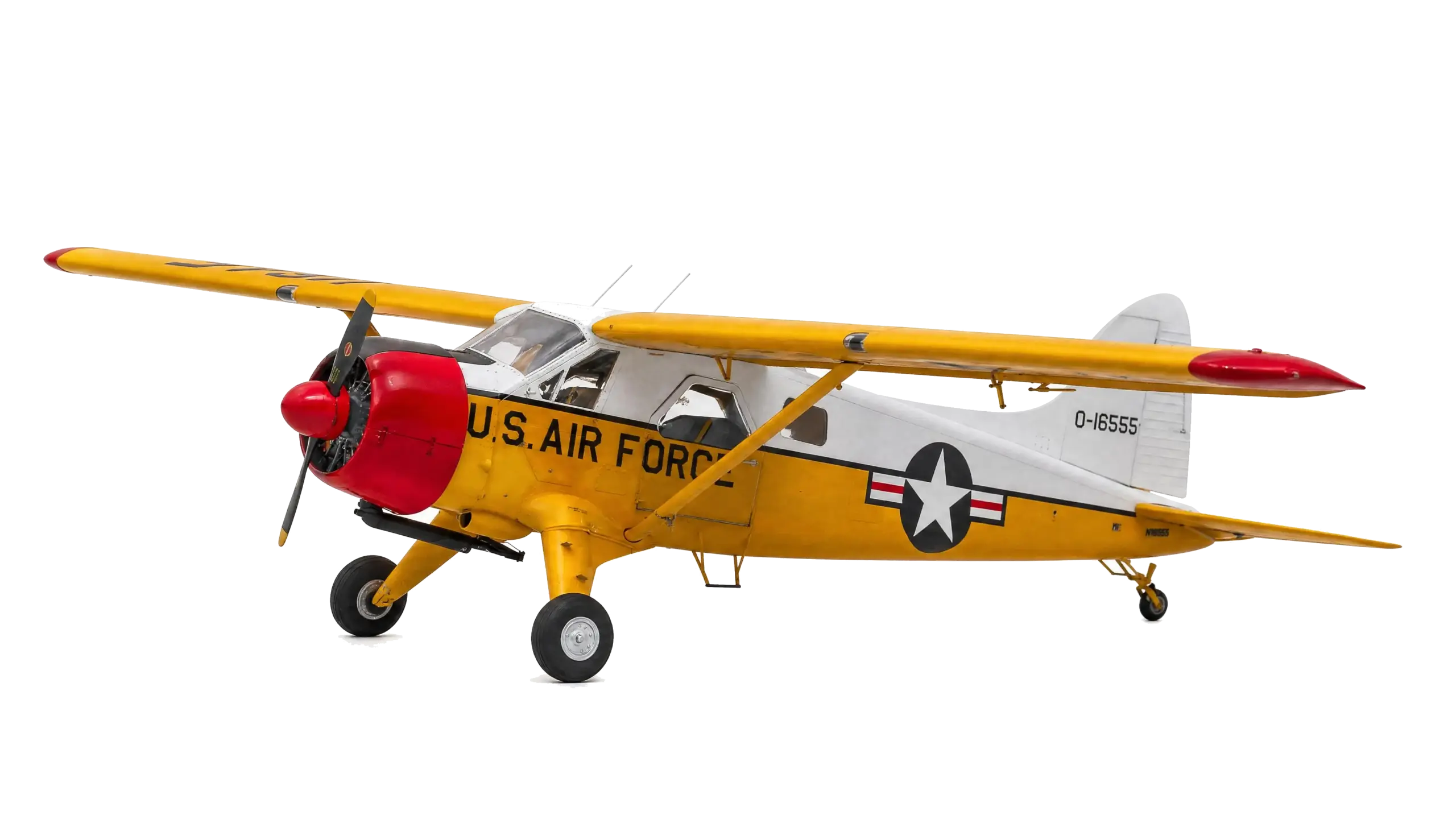
de Havilland Canada DHC-2 Beaver
Aircraft Collection
The de Havilland Canada DHC-2 Beaver is one of the defining aircraft of the North:
a working machine built to carry people, cargo, fuel, tools, and supplies into places without roads.
Overview
The DHC-2 Beaver was created for a type of flying where the runway might be water,
packed snow, a short gravel strip, or a clearing at the edge of a forest. Its high wing, large flaps,
radial engine, wide landing gear, and rugged all-metal structure gave it the ability to work where
conventional transport aircraft simply could not go.
The Beaver was designed with working pilots in mind. It needed to carry a serious load, remain controllable
at low speed, tolerate rough operating conditions, and allow cargo to move quickly through its large cabin doors.
The result was an aircraft that became more than a utility machine. It became a symbol of Canadian bush flying.
Its personality is direct and mechanical. The large radial engine dominates the nose, the high wing creates
a strong working silhouette, and every part of the airframe looks built for a reason rather than for decoration.
Operational Use
Beaver aircraft have served as passenger transports, cargo carriers, survey platforms, medical evacuation
aircraft, floatplanes, ski-equipped winter transports, forestry machines, charter aircraft, and remote-area
lifelines. Their operating environment was often defined by weather, distance, and terrain rather than airport infrastructure.
The aircraft also entered military service in several countries, including the United States, where it served
in liaison and utility roles. Yet its strongest identity remains civilian: the dependable bush aircraft that
connected isolated communities, lakes, camps, mines, and work sites to the rest of the world.
Historical Context
The Beaver arrived in the immediate postwar period, when de Havilland Canada chose to build an aircraft around
the real needs of northern operators. Rather than adapting a military design, the company created a purpose-built
civilian utility platform with short takeoff and landing capability at the center of its concept.
Production continued until 1967, but the aircraft never truly left service. Many Beavers were rebuilt,
modernized, converted to turbine power, or adapted for floats and skis. Their continued use is the clearest
proof of the design’s value: a practical aircraft can become timeless when it solves the right problems.
Model Focus
This project is developed as a faithful flying reproduction of the original airframe,
not merely a generic high-wing utility model. The radial-engine nose, broad cabin, high-wing geometry,
wing struts, flap layout, tailwheel stance, cargo-door proportions, and working-aircraft profile are treated
as defining structural elements.
The model is designed around full functional mechanization of the airframe wherever the
original design makes it meaningful: moving control surfaces, scale flap operation, realistic tailwheel steering,
mechanically credible landing gear, navigation lighting, and detailed wing-and-strut geometry.
Advanced configurations can be developed around the Beaver’s unique operating character: progressive flap settings,
stable low-speed handling, controlled radial-style throttle response, lighting sequences, and optional wheel,
float, or ski-oriented equipment concepts that reflect the adaptability of the original aircraft.
Custom Finish
The Beaver is ideal for a custom-finished individual aircraft. A build can be developed around
a real registration, bush operator colors, forestry markings, floatplane paint, northern charter schemes,
weathered utility finishes, cargo-door details, or a clean owner-operated restoration style.
The aim is not a generic yellow bush plane. It is a believable working aircraft with its own history:
an airplane that looks ready to leave a lake, cross a mountain range, or deliver supplies somewhere
that has no runway, no road, and no easy alternative.
The Beaver should look capable before it ever leaves the ground.
Its scale character comes from visible utility, working mechanics, STOL geometry, and the confidence of an aircraft built for places where aviation is essential.
Wronsky Aeroworks Model
Every Wronsky Aeroworks model is individually finished by hand, receives its own serial number, and undergoes detailed quality inspection before shipment. Each aircraft is produced in limited numbers with an emphasis on historical accuracy, clean geometry, crisp surface detail, and premium presentation.