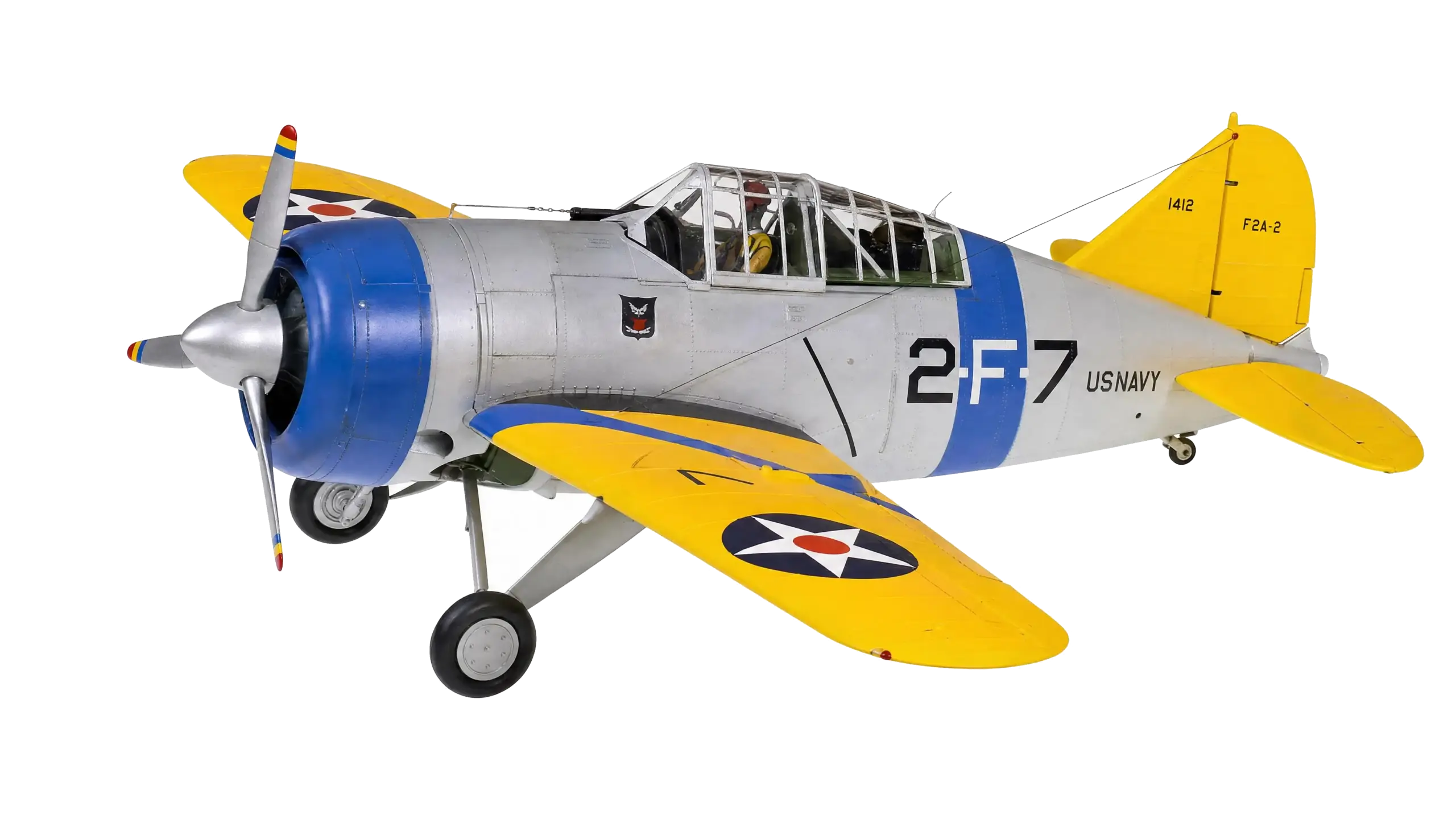
Brewster F2A-2 Buffalo
Aircraft Collection
The Brewster F2A-2 Buffalo was a fighter built at the turning point between naval biplanes and modern carrier aviation:
compact, all-metal, retractable, and designed to prove that a monoplane could operate from an American carrier deck.
Overview
The Brewster Buffalo was one of the aircraft that marked the end of the naval fighter biplane.
Its enclosed cockpit, retractable landing gear, radial engine, all-metal construction, and arresting hook made it
look modern beside the Grumman F3F it was intended to replace.
The Buffalo had a compact, almost rounded character. Its short fuselage, wide radial cowling, low wing,
framed canopy, and retractable undercarriage created a fighter that looked more like a product of the coming war
than the era it was replacing.
In its early form, the aircraft was liked by several Navy and Marine pilots for its responsive handling,
turning ability, and compact feel. Its problem was not that the original concept lacked promise.
The problem was that the airframe reached its limits while the war moved faster than the Buffalo could evolve.
Operational Use
The F2A entered U.S. Navy service in 1939 and became the Navy’s first operational monoplane fighter.
The F2A-2 served with carrier and shore-based units before the heavier F2A-3 entered wartime service
with Marine squadrons in the Pacific.
Export variants served with Finland, Britain, Australia, New Zealand, Belgium, and the Netherlands East Indies.
Their combat records differed sharply depending on theater, aircraft configuration, maintenance, pilot training,
and the opponents they faced.
The Finnish B-239 export version became especially notable in the Winter War and Continuation War,
where skilled pilots used the lightweight Buffalo against Soviet aircraft under very different conditions
from those faced by U.S. Marines at Midway or Commonwealth squadrons in Southeast Asia.
Historical Context
The Buffalo was designed in response to a U.S. Navy requirement for a new generation of carrier fighters.
Its first flight in 1937 came at a moment when naval aviation was changing rapidly:
speed was increasing, landing gear was disappearing into wings, and fighter design was shifting toward enclosed,
stressed-skin monoplanes.
Brewster won the initial Navy competition against an early Grumman proposal, but the Buffalo’s development
was undermined by production problems and rapid increases in required equipment, armor, fuel capacity,
and armament. Later versions became heavier without receiving the power increase necessary to preserve
the original balance of the design.
That contradiction makes the Buffalo historically interesting. It was neither simply a failure nor simply
a success. It was a transitional fighter whose strengths were real, but whose timing proved unforgiving.
Notable Pilots
The early F2A is associated with Gregory “Pappy” Boyington, who later recalled that
the lighter early Buffalo variants were pleasant and maneuverable aircraft before added equipment increased weight.
Boyington’s better-known combat career came later with the Marine Corps and the F4U Corsair.
The Buffalo’s strongest combat record came from Finnish pilots flying the related B-239 export version.
Pilots such as Hans Wind, Eino Ilmari Juutilainen, and
Jorma Karhunen became closely associated with the type in Finnish service.
Their aircraft provide valuable references for custom historical finishes, though they were export-model Buffalos
rather than U.S. Navy F2A-2 machines.
Model Focus
This project is developed as a faithful flying reproduction of the original airframe,
not a generic early-war fighter silhouette. The radial-engine cowling, compact fuselage, framed canopy,
low wing, retractable landing gear, arresting-hook geometry, tailwheel stance, and rounded Buffalo profile
are treated as essential structural features.
The model is designed around full functional mechanization of the airframe wherever
the real aircraft makes it meaningful: working control surfaces, retractable landing gear,
scale flap movement, mechanically credible gear doors, tailwheel behavior, authentic radial-engine detailing,
and carefully proportioned canopy and wing geometry.
In advanced configurations, the onboard controller can support a Buffalo-specific flight profile:
smooth radial-engine-style throttle response, measured takeoff power application, progressive flap deployment,
carrier-inspired lighting and sequencing, and scale timing appropriate to a compact prewar naval fighter.
Custom Finish
Every Buffalo can be developed as a custom-finished individual aircraft.
A build may draw from prewar U.S. Navy carrier markings, early-war blue-gray schemes, Finnish B-239 camouflage,
Dutch East Indies colors, Commonwealth Buffalo markings, tactical numbers, personal details, exhaust staining,
faded paint, field repairs, and weathering appropriate to a chosen theater.
The objective is not a generic early-war radial fighter. It is a historically credible individual aircraft
with a finish, surface depth, and visual identity matching the precision of a fully mechanized scale airframe.
The Buffalo should look like a fighter caught between two eras.
Its scale character comes from compact carrier-fighter geometry, visible mechanics, radial-engine presence, and the unusual story of a design that changed depending on where it fought.
Wronsky Aeroworks Model
Every Wronsky Aeroworks model is individually finished by hand, receives its own serial number, and undergoes detailed quality inspection before shipment. Each aircraft is produced in limited numbers with an emphasis on historical accuracy, clean geometry, crisp surface detail, and premium presentation.