Curtiss P-40E Warhawk
Aircraft Collection
The Curtiss P-40E Warhawk was an American fighter built for practical combat:
rugged, heavily armed, fast in a dive, and defined by the unmistakable shark-like line of its long Allison-powered nose.
Overview
The P-40 Warhawk was never designed to win every fight through altitude or elegance.
It was built to survive rough operating conditions, deliver meaningful firepower, and remain dangerous where
low-level speed, dive performance, and structural toughness mattered more than theoretical perfection.
The P-40E gave the aircraft a more mature and more aggressive appearance. Its redesigned nose, deep chin radiator,
broad wing roots, long cockpit section, and six .50 caliber machine guns created a fighter that looked built
for hard service rather than airshow finesse.
The Warhawk’s character came from that honesty. It was not a high-altitude specialist, but at lower and medium
levels it could dive hard, roll cleanly, absorb damage, and fight with a direct mechanical confidence that earned
deep respect from the pilots who learned how to use its strengths.
Operational Use
P-40s served with American and Allied air forces across North Africa, the Mediterranean, China-Burma-India,
the Southwest Pacific, the Soviet Union, and several other wartime theaters. In British and Commonwealth service,
later variants were known as Kittyhawks.
The Warhawk performed best where combat remained below the altitudes that favored more highly supercharged
European fighters. It became particularly effective in escort, interception, close-support, armed reconnaissance,
and fighter-bomber roles.
Bomb racks and six heavy machine guns gave the P-40E real flexibility. It could attack vehicles, supply columns,
airfields, gun positions, and ground targets while remaining capable of defending itself in the air.
It was a machine that demanded discipline, but it rewarded pilots who understood energy, speed, and timing.
Historical Context
The P-40 emerged from the Curtiss P-36 Hawk, but the replacement of the radial engine with the liquid-cooled
Allison V-1710 created a completely different visual and operational identity. The slimmer nose promised better
aerodynamics, while the large under-nose cooling intake became one of the type’s most recognizable details.
By the time the United States entered World War II, the P-40 was no longer the most advanced fighter in every category.
Yet it remained available in large numbers, could be maintained in difficult conditions, and fit the needs of theaters
where range, toughness, and low-altitude combat performance carried more weight than extreme high-altitude capability.
Its legacy is inseparable from the men and units that made it famous. The P-40 was not an effortless aircraft.
It had to be flown with purpose. That makes it one of the most interesting American fighters to reproduce as a serious scale aircraft.
Notable Pilots
The P-40 family is associated with pilots including Claire Chennault,
David “Tex” Hill, Charles Older, and
Clive Caldwell. Their combat records were earned in different versions and theaters,
but together they helped establish the Warhawk and Kittyhawk as major Allied fighters of the early war.
The Flying Tigers remain the most recognizable P-40 story, although their aircraft were earlier Tomahawk variants.
For a P-40E custom build, the visual language can instead draw from North African Kittyhawks, Pacific Theater aircraft,
U.S. Army Air Forces machines, or Allied desert schemes with shark mouths, theater markings, tactical codes,
fading paint, dust, oil staining, and field-repaired surfaces.
Model Focus
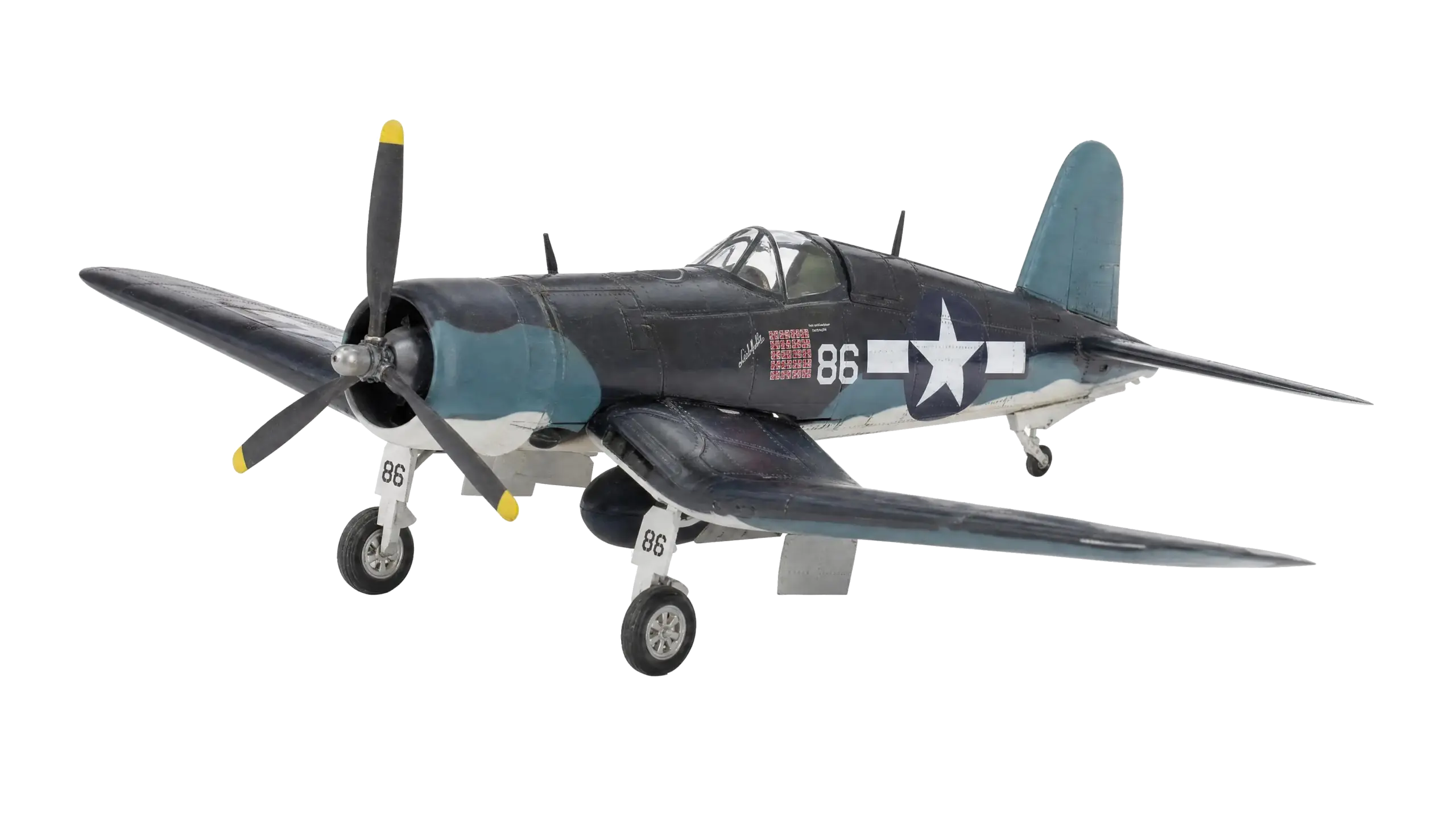
This project is developed as a faithful flying reproduction of the original airframe,
not a generic American fighter silhouette. The long Allison nose, deep radiator intake, cockpit framing,
wing-root geometry, six-gun wing profile, tailwheel stance, and narrow retractable landing gear are treated
as essential structural features of the P-40E.
The model is designed around full functional mechanization of the airframe wherever
the original aircraft makes it meaningful: working control surfaces, retractable main landing gear,
scale flap movement, mechanically credible gear doors, radiator detailing, tailwheel behavior,
and accurately proportioned control-surface movement.
In advanced configurations, the onboard controller can support a Warhawk-specific flight profile:
progressive power delivery, deliberate takeoff management, synchronized landing-gear and flap sequences,
navigation lighting, and scale-function timing that reflects a low-altitude combat aircraft rather than
a generic electric warbird.
Custom Finish
Every P-40 can become a custom-finished individual aircraft. A build may be developed
around a documented squadron, a desert Kittyhawk, a Pacific Theater machine, a U.S. Army Air Forces aircraft,
a shark-mouth scheme, tactical markings, weathered camouflage, field repairs, operational staining,
or a carefully researched restoration-inspired finish.
The objective is not a generic olive-drab fighter with painted teeth on the nose. It is a
historically credible individual aircraft with surface depth, visible use,
custom markings, and finishing quality worthy of a fully mechanized scale airframe.
The P-40 should look ready for a rough field and a hard fight.
Its scale character comes from the long Allison nose, radiator geometry, visible mechanics, and the direct, durable confidence of an early-war American fighter.
Wronsky Aeroworks Model
Every Wronsky Aeroworks model is individually finished by hand, receives its own serial number, and undergoes detailed quality inspection before shipment. Each aircraft is produced in limited numbers with an emphasis on historical accuracy, clean geometry, crisp surface detail, and premium presentation.