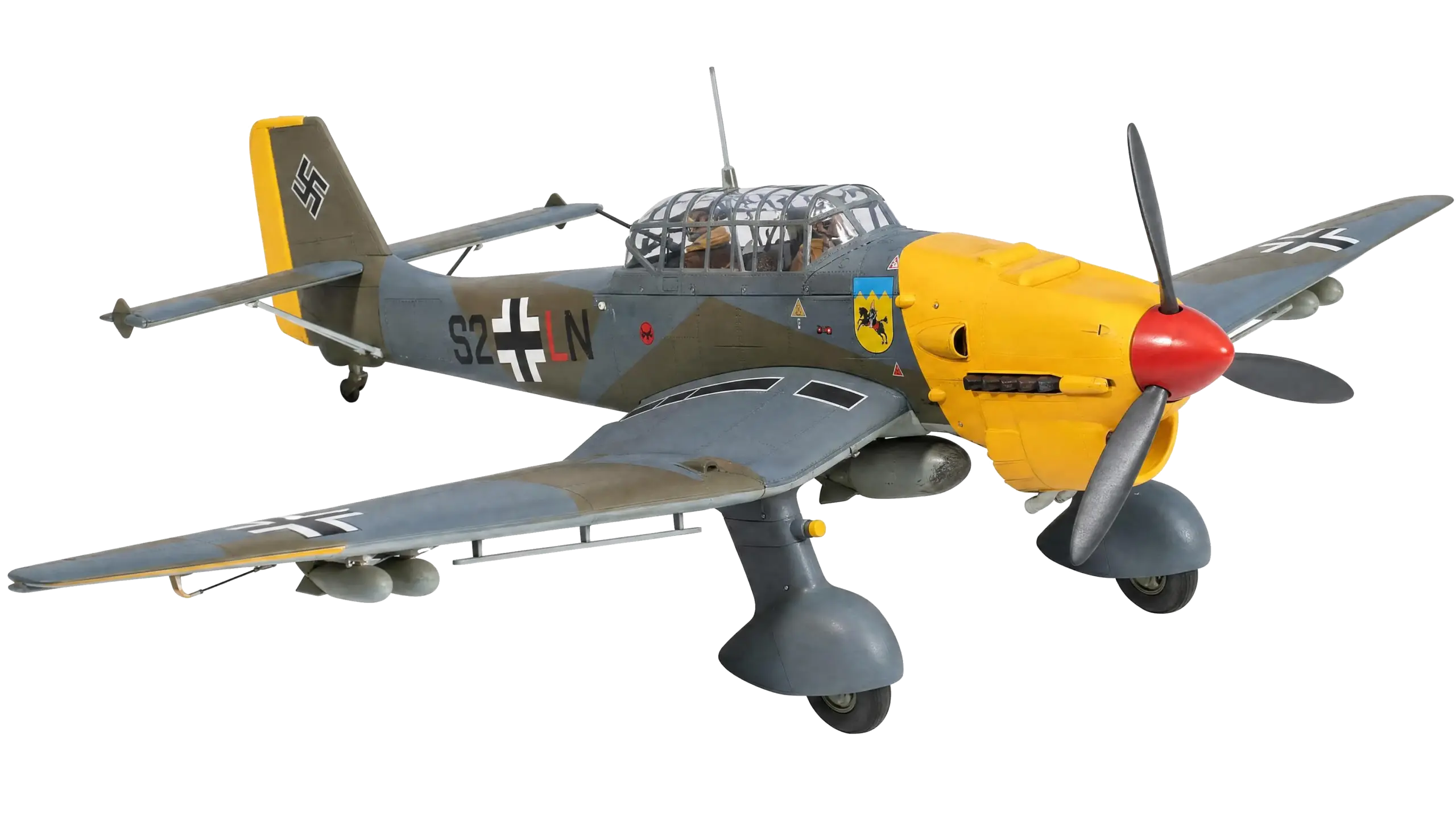
Junkers Ju 87 B-2 Stuka
Aircraft Collection
The Junkers Ju 87 B-2 Stuka was one of the most recognizable aircraft of World War II:
a purpose-built dive bomber whose shape, sound, and attack profile became inseparable from the idea of precision air attack.
Overview
The Ju 87 Stuka was not designed to be subtle. Everything about it was engineered around one core mission:
delivering bombs with precision from a steep dive. Its fixed landing gear, cranked inverted gull wing, deep fuselage,
greenhouse canopy, and large wheel spats gave it a silhouette that remains instantly recognizable.
The aircraft’s identity came from function. Dive brakes, bomb crutch geometry, strong airframe construction, and excellent
pilot visibility were not cosmetic features. They were the heart of a machine intended to place ordnance with accuracy
rather than rely on speed or fighter-like agility.
The Ju 87 also carried one of the most infamous sound signatures of the war. Early examples used the
Jericho-Trompete siren, a psychological weapon as much as an acoustic one, turning the aircraft into a symbol
of fear long before the bomb actually struck.
Operational Use
The Stuka became closely associated with the early campaigns of the Second World War, especially in Poland, France,
the Low Countries, the Balkans, and the opening stages of Operation Barbarossa. It was used for battlefield support,
anti-armor attacks, interdiction, bridge strikes, and attacks on troop concentrations and shipping.
At its best, the Ju 87 was devastating when air superiority existed or enemy fighter opposition was limited.
Its ability to attack with precision made it highly effective in combined-arms operations. At the same time,
its relatively low speed and fixed gear made it increasingly vulnerable once opposed by modern fighters in contested skies.
Historical Context
First flown in 1935, the Ju 87 became one of the defining aircraft of early-war German air power.
It fit perfectly into the operational doctrine of rapid, concentrated attack in support of advancing ground forces.
Few aircraft of the period became so visually and psychologically linked to a specific style of warfare.
The aircraft’s uncompromising form still feels unique today. It was not elegant in the conventional sense,
but it was intensely purposeful. The angular canopy, spatted undercarriage, dive brakes, and inverted gull wing
make the Ju 87 look exactly like what it was: a machine designed around a violent and specialized task.
Notable Pilots
The Ju 87 is strongly associated with pilots such as Hans-Ulrich Rudel,
Helmut Mahlke, and Ernst Kupfer. Their service records covered different
phases of the war and different Ju 87 variants, but the aircraft remained central to the Luftwaffe’s dive-bomber arm.
For a historically grounded custom build, Rudel’s operational aircraft and early-war Stukas from the Polish and French campaigns
provide especially strong visual references: unit markings, tactical numbers, yellow theater bands, weathering,
field wear, and a finish that reflects real use rather than a museum-clean fantasy.
Model Focus
This project is developed as a faithful flying reproduction of the original airframe, not a simplified profile
of a famous dive bomber. The inverted gull wing, fixed spatted landing gear, broad canopy framing, deep fuselage,
tail geometry, and under-fuselage bomb installation are treated as essential structural features.
The model is designed around full functional mechanization of the airframe wherever that mechanism defines
the real aircraft: moving control surfaces, scale flap operation, mechanically credible landing gear detailing,
authentic dive-brake representation, and—in advanced custom configurations—a realistic bomb crutch or deployment mechanism.
The onboard control architecture can also be configured for coordinated scale behavior, including staged control response,
dive-related function sequencing, and custom actuation timing. The goal is to preserve the operational logic of the original aircraft,
not merely to reproduce its outline.
Custom Finish
Every Stuka benefits from a custom-finished historical identity. That may include documented unit camouflage,
theater markings, tactical codes, fuselage bands, underside colors, field-applied paint variation, exhaust staining,
mud and dust effects, and mission-specific bomb markings.
The objective is not a generic warbird finish. It is a specific operational aircraft with authentic visual character,
finished to a standard that matches the precision of a fully mechanized scale airframe.
The Ju 87 should look specialized, deliberate, and slightly intimidating.
Its scale character comes from the mechanism, the attack geometry, the fixed-gear stance, and the unmistakable identity of a true dive bomber.
Wronsky Aeroworks Model
Every Wronsky Aeroworks model is individually finished by hand, receives its own serial number, and undergoes detailed quality inspection before shipment. Each aircraft is produced in limited numbers with an emphasis on historical accuracy, clean geometry, crisp surface detail, and premium presentation.