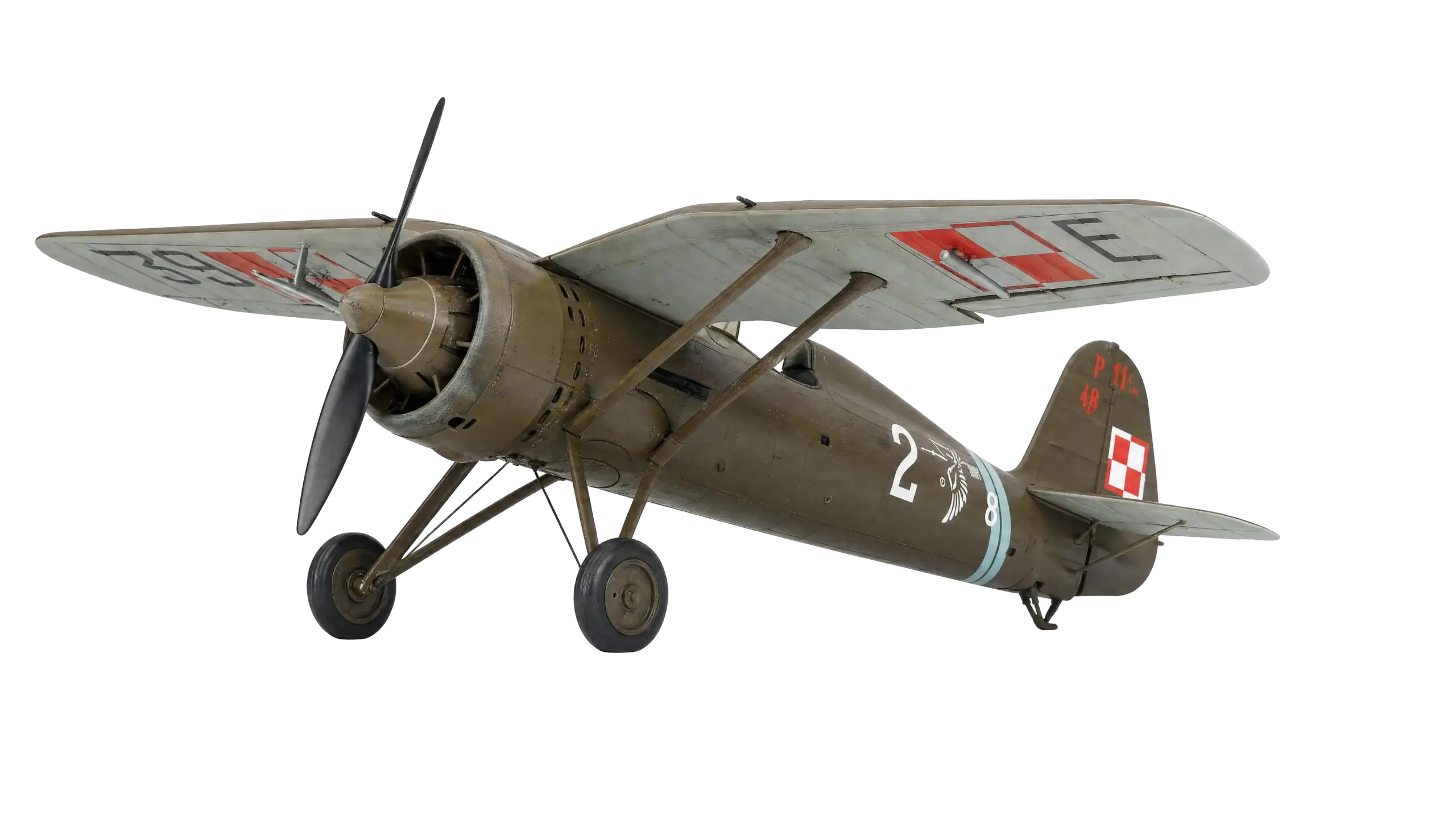
PZL P.11c
Aircraft Collection
The PZL P.11c was Poland’s fighter at the edge of two aviation eras:
modern and innovative when introduced, yet forced into combat against a new generation of faster aircraft only a few years later.
Overview
The PZL P.11c is one of the most distinctive fighters of the 1930s.
Its defining feature was the high-mounted gull wing created by Polish designer
Zygmunt Puławski—a shape that gave the pilot unusually clear forward and downward visibility
while creating an unmistakable silhouette.
At a time when many air forces still depended on biplanes, the P.11 was an all-metal monoplane fighter
with a radial engine, open cockpit, corrugated metal skin, and a clean high-wing layout.
It was not designed to be elegant in a decorative sense. Its form came directly from structure, visibility,
and practical combat use.
By 1939, rapid advances in aviation had left the P.11c technically outmatched by modern German fighters.
Yet its maneuverability, short-field capability, durable construction, and excellent pilot visibility
gave Polish pilots a machine that could still fight with intelligence and determination.
Operational Use
The P.11c served as the principal Polish fighter during the late 1930s and formed the core of Poland’s
front-line fighter squadrons when Germany invaded in September 1939. It operated from dispersed,
improvised airfields rather than remaining concentrated at vulnerable major bases.
The aircraft flew interception, defensive patrol, escort, and direct combat missions against German bombers
and fighters. Its pilots faced aircraft with greater speed, more modern armament, and better communications,
but the P.11’s low-speed control, short takeoff performance, and visibility still made it useful in the right hands.
Historical Context
The P.11c represents an important moment in Polish aviation history. When it entered service, it was regarded
as one of the more advanced fighters in Europe. The all-metal structure and Pulawski wing placed Poland among
the countries capable of producing original, internationally recognized aircraft designs.
Its story is also a reminder of how quickly aviation changed in the late 1930s. Fixed landing gear,
an open cockpit, limited radio equipment, and moderate engine power became serious disadvantages once
modern enclosed-cockpit fighters with retractable gear entered service.
Today, the P.11c is remembered not because it was the fastest fighter of 1939, but because it became
a symbol of Polish resistance under conditions that were militarily unequal from the beginning.
Notable Pilots
The P.11c is associated with Polish pilots such as Władysław Gnyś,
Stanisław Skalski, Mieczysław Medwecki, and
Mirosław Leśniewski. Their experiences represent the difficult opening days
of the September Campaign, when Polish squadrons fought with aircraft already nearing the end of their operational life.
For a custom historical build, early-war Polish markings provide unusually strong reference material:
white-and-red checkerboards, squadron insignia, tactical numbers, field-applied camouflage,
weathering from improvised airstrips, exhaust staining, dust, and the unmistakable visual language
of Polish military aviation in 1939.
Model Focus
This project is developed as a faithful flying reproduction of the original airframe,
not a generic prewar fighter silhouette. The Pulawski gull wing, open cockpit, corrugated metal panels,
exposed radial-engine profile, fixed undercarriage, tail skid, wing bracing, and tall fighter stance
are treated as essential structural features.
The model is designed around full functional mechanization of the airframe wherever
the original structure makes it meaningful: working control surfaces, scale-correct aileron movement,
credible tail-skid or tailwheel behavior depending on configuration, accurate landing-gear geometry,
realistic wing structure, and carefully reproduced surface detailing.
In advanced configurations, the onboard controller can support a P.11c-specific flight profile:
measured radial-engine throttle response, stable low-speed handling, deliberately visible control movement,
scale lighting, and timing that reflects a lightweight open-cockpit fighter rather than a generic electric model.
Custom Finish
Every P.11c benefits from a custom-finished historical identity. A build can be developed
around a documented squadron aircraft, a specific tactical number, period-correct Polish national markings,
weathered camouflage, engine staining, field repairs, worn wing surfaces, or a museum-inspired restoration finish.
The goal is not a simplified green-and-khaki warbird. It is a credible individual aircraft
with the proportions, surface detail, historical character, and custom finishing quality worthy of a fully mechanized scale airframe.
The PZL P.11c should look original because the original design truly was.
Its scale character comes from the Pulawski wing, visible mechanics, corrugated structure, and the distinct identity of Poland’s prewar fighter.
Wronsky Aeroworks Model
Every Wronsky Aeroworks model is individually finished by hand, receives its own serial number, and undergoes detailed quality inspection before shipment. Each aircraft is produced in limited numbers with an emphasis on historical accuracy, clean geometry, crisp surface detail, and premium presentation.