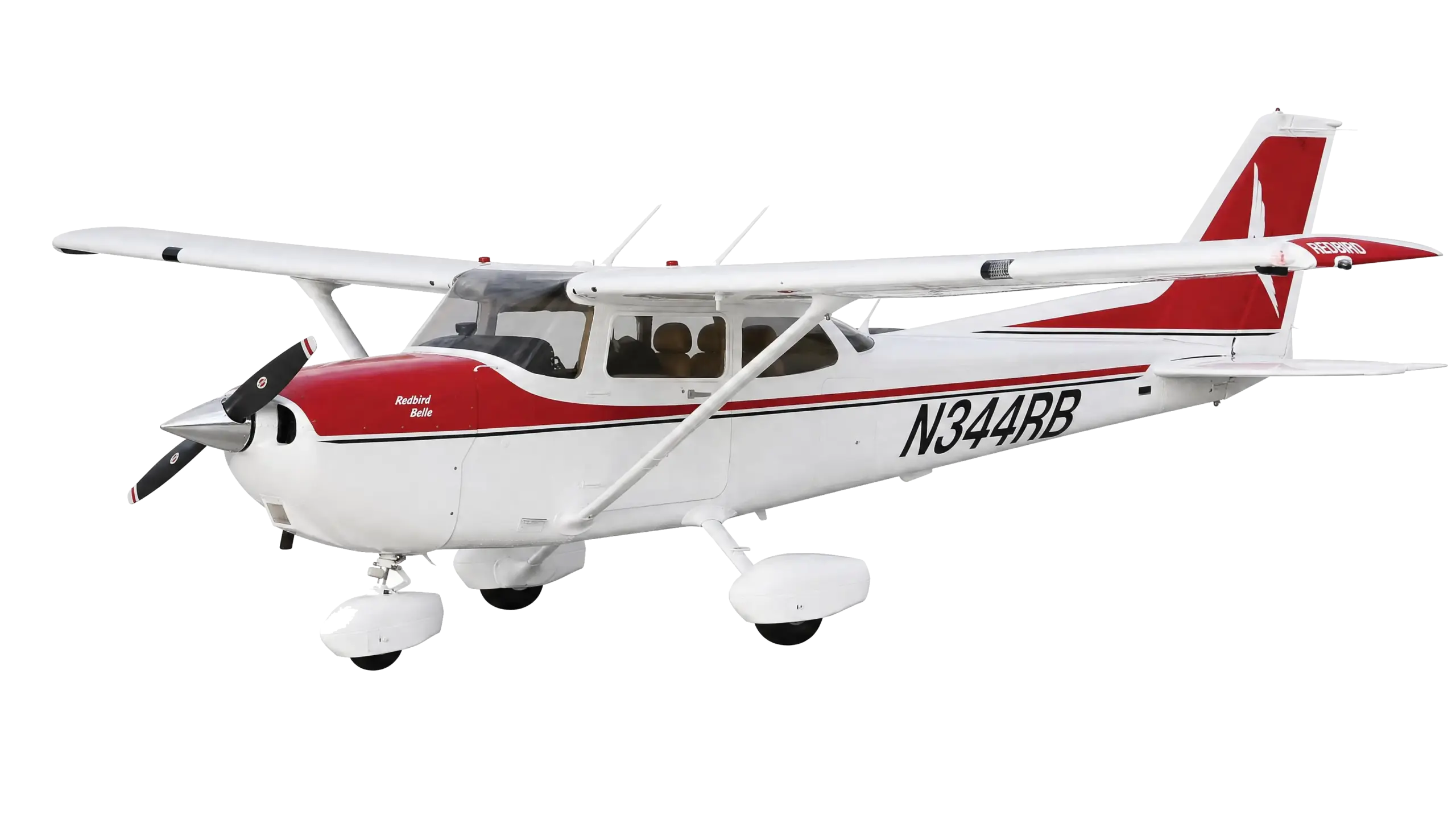
Cessna 172S Skyhawk
Aircraft Collection
The Cessna 172 Skyhawk is the airplane that made general aviation feel accessible:
stable, practical, familiar, and capable of turning a first lesson into a lifetime of flying.
Overview
The Cessna 172 Skyhawk is not famous because it is exotic. It is famous because it works.
The high wing gives pilots excellent visibility, the tricycle landing gear removes much of the intimidation
associated with tailwheel aircraft, and the cabin offers enough space for training, touring, photography,
and everyday cross-country flying.
Its design is straightforward but never crude. The wing, cabin, nose gear, strut-braced structure, and
fixed-pitch propeller all contribute to an aircraft that feels predictable in the air and approachable
on the ground. That is why the Skyhawk became a benchmark rather than simply another light airplane.
The 172S represents the mature form of that idea: a stronger 180-horsepower engine, modern avionics,
fuel injection, and the same unmistakable silhouette that has defined American training fields for decades.
Operational Use
The Skyhawk has served as a primary training aircraft, family touring machine, rental platform,
business transport, aerial observation aircraft, and general-purpose utility airplane. It is equally
at home on a paved runway outside a major city or on a smaller field where aviation still feels personal.
Flight schools value it because it teaches the important habits without hiding mistakes. Private owners
value it because it is practical, understandable, and capable enough to turn a weekend flight into a
real journey. That mix of stability and usability is the reason the 172 remains a standard reference point
in American general aviation.
Historical Context
The first Cessna 172 flew in 1955 as a development of the earlier Cessna 170, but with tricycle landing
gear instead of a tailwheel arrangement. That change was fundamental. It made the airplane easier to operate
for a much wider group of pilots and helped establish the tricycle-gear trainer as the American norm.
Over the decades, the 172 family evolved through different engines, instrument layouts, cabin refinements,
aerodynamic updates, and avionics packages. Yet the aircraft never lost its core identity:
a high-wing utility airplane designed to make flying feel manageable without making it feel dull.
Model Focus
This project is conceived as a faithful flying reproduction of the original airframe,
not simply a generic high-wing civilian model. The cabin proportions, wing struts, fixed tricycle landing
gear, nose-wheel geometry, flap line, windshield profile, and stabilizer layout are treated as defining
features of the real Skyhawk.
The model is developed around full functional mechanization of the airframe where the
structure of the original makes it meaningful: working control surfaces, scale-correct flap operation,
believable nose-wheel steering, landing-light placement, navigation lighting, and a mechanically credible
relationship between the wing, struts, fuselage, and landing gear.
In advanced configurations, the onboard controller can support a Cessna-specific flight profile:
smooth throttle response, stable low-speed handling, progressive flap deployment, realistic lighting
sequences, and the calm, predictable rhythm that makes a Skyhawk feel different from a generic electric model.
Custom Finish
The Cessna 172 is ideal for custom-finished individual aircraft. A build can be developed
around a real registration, flight-school identity, vintage paint layout, modern private-owner scheme,
polished trim, interior color selection, local airport markings, or a fully original design that still feels
authentic to the aircraft.
The goal is not a generic white trainer with a stripe. It is a recognizable Skyhawk with personality:
a specific aircraft that looks like it belongs to a real owner, a real airfield, and a real aviation story.
The Cessna 172 should feel familiar for a reason.
Its scale character comes from practical geometry, visible mechanics, predictable handling, and the quiet confidence of the airplane that taught America to fly.
Wronsky Aeroworks Model
Every Wronsky Aeroworks model is individually finished by hand, receives its own serial number, and undergoes detailed quality inspection before shipment. Each aircraft is produced in limited numbers with an emphasis on historical accuracy, clean geometry, crisp surface detail, and premium presentation.