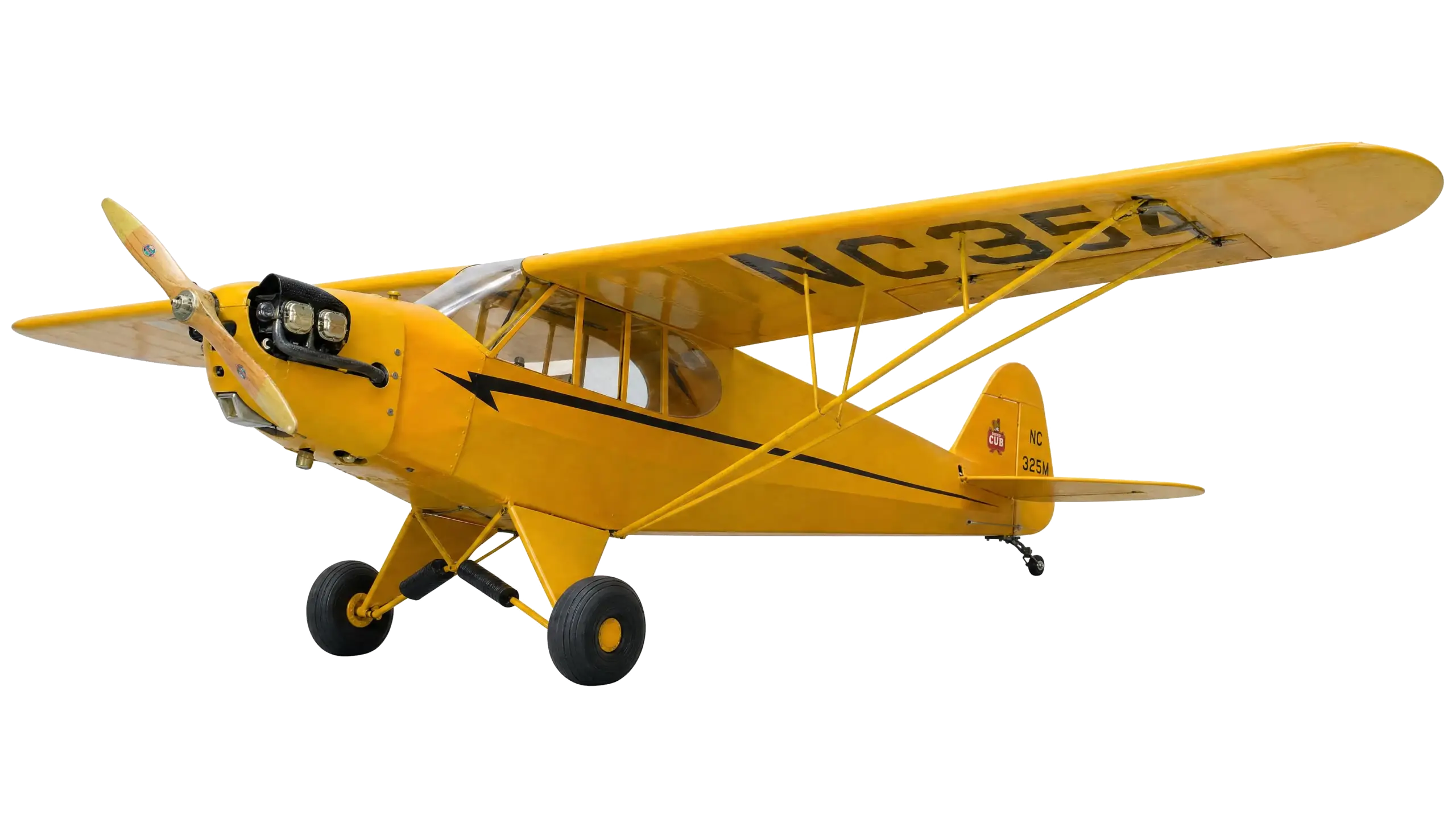
Piper J-3 Cub
Aircraft Collection
The Piper J-3 Cub helped define what personal flying looked like in America:
light, direct, mechanical, and unmistakably human.
Overview
The J-3 Cub was built around an idea that still resonates with American pilots:
an airplane should be approachable without being dull. Its high wing, tandem cockpit,
tailwheel landing gear, exposed cylinder heads, and unmistakable Cub Yellow
finish created a silhouette that remains instantly recognizable nearly a century later.
It was not a fast machine and it was never meant to be one. The Cub’s strength was its
honest, uncomplicated flying character. Low-speed handling, light controls,
and a simple fabric-covered airframe made it an ideal trainer for pilots learning to fly
by feel rather than by automation.
That simplicity also made the design adaptable. During World War II, the Cub family evolved
into the military L-4 Grasshopper, proving that a small aircraft with the right balance of
visibility, short-field capability, and reliability could become a useful tool close to the front line.
Operational Use
In civilian life, the J-3 became a fixture at local airports, flight schools, and rural
grass strips across the United States. It introduced thousands of pilots to the fundamentals
of takeoffs, coordinated turns, landings, wind correction, and conventional tailwheel handling.
Its military relatives served in observation, liaison, artillery spotting, reconnaissance,
courier work, and casualty evacuation. The Cub was never designed to impress through raw
performance. It earned its reputation by being useful, forgiving, and dependable.
Historical Context
Introduced in 1938, the J-3 arrived when aviation in the United States was becoming more
accessible to ordinary people. Its welded steel-tube fuselage, fabric-covered structure,
strut-braced wing, and modest Continental engine created an aircraft that could be maintained
without the complexity of larger commercial machines.
The Cub became more than an airplane. It became a visual shorthand for American grassroots
aviation: open fields, simple hangars, hands-on maintenance, and the first real feeling of
leaving the ground under your own control.
Model Focus
This project is conceived as a faithful flying reproduction of the original airframe,
rather than a simplified display model. Its narrow fabric-covered fuselage, high-wing stance,
exposed support struts, conventional tailwheel geometry, and exposed mechanical character are
treated as defining elements of the aircraft—not optional decoration.
The model is designed around full functional mechanization of the airframe wherever
the original structure demands it: moving control surfaces, accurate wing and tailplane geometry,
mechanically credible landing gear behavior, and structural details that make the aircraft feel
engineered instead of merely styled.
Flight behavior receives the same level of attention as the exterior. The intended setup favors
measured throttle response, stable low-speed manners, and a calm, deliberate rhythm in the air—
qualities that belong to a Cub and would feel wrong on a generic high-performance model.
A faithful scale aircraft should do more than resemble the original.
It should reveal how the original was built, how it moved, and why pilots remember it.
Wronsky Aeroworks Model
Every Wronsky Aeroworks model is individually finished by hand, receives its own serial number, and undergoes detailed quality inspection before shipment. Each aircraft is produced in limited numbers with an emphasis on historical accuracy, clean geometry, crisp surface detail, and premium presentation.