Supermarine Spitfire Mk XIV
Aircraft Collection
The Supermarine Spitfire Mk XIV was the Spitfire transformed by raw Griffon power:
faster, more forceful, and more demanding than the Merlin-powered fighters that made the name famous.
Overview
The Spitfire Mk XIV was not simply a later Spitfire with a more powerful engine.
It was a major change in character. The larger Rolls-Royce Griffon engine, five-bladed propeller,
revised nose profile, enlarged vertical tail, and increased power transformed the aircraft into
one of the fastest piston-engine fighters ever to carry the Spitfire name.
Its famous elliptical wing remained, but almost everything around it felt more intense.
The longer nose, powerful propeller, radiator arrangement, and sharply increased torque gave the Mk XIV
a more muscular presence than earlier Merlin variants. It retained the clean aerodynamic lines of the Spitfire,
but it no longer behaved like a gentle evolution of the original 1936 fighter.
Pilots respected the Mk XIV because it demanded precision. The Griffon engine gave exceptional climb
and acceleration, but the aircraft needed disciplined use of throttle and rudder, especially during takeoff.
In the air, however, it had the power to surprise enemy fighters that expected a Spitfire to remain below them.
Operational Use
The Spitfire Mk XIV entered operational service late in 1943 and became one of the RAF’s most effective
answers to the V-1 flying bomb campaign. Its speed allowed pilots to intercept targets that earlier
fighter variants struggled to reach consistently.
It later served with the Second Tactical Air Force over northwestern Europe in air-superiority,
armed-reconnaissance, interception, and fighter-sweep roles. Mk XIV squadrons operated against
German fighters, ground targets, transport routes, and late-war threats including jet aircraft.
The Griffon-powered Spitfire was fast enough to remain dangerous until the final months of the war.
It represented the point at which the basic Spitfire concept had been pushed to its most powerful
and uncompromising wartime form.
Historical Context
The Mk XIV emerged from the need to give the Spitfire substantially greater high-altitude performance.
The two-stage-supercharged Griffon 65 delivered a major improvement over the earlier single-stage Griffon
installations and gave the aircraft a dramatic increase in speed, climb, and acceleration.
The aircraft was initially based on the Spitfire Mk VIII airframe, but production machines evolved further
through revised armament, stronger landing gear, modified fuel arrangements, cut-down rear fuselages,
and bubble canopies on later examples. That variety makes the Mk XIV especially interesting for custom,
historically specific scale builds.
Notable Pilots
The Mk XIV is associated with pilots including Squadron Leader John Shepherd and
Wing Commander Peter Brothers, as well as the RAF pilots of 610, 41, 91, and other
Griffon-Spitfire squadrons. Shepherd flew Mk XIVs with 610 Squadron during the V-1 interception campaign
and later with 41 Squadron over Germany.
A historically grounded custom build can be developed around V-1 interception aircraft, late-war
Second Tactical Air Force machines, continental camouflage, invasion stripes where reference material supports them,
squadron codes, spinner colors, exhaust staining, chipped paint, and the distinctive hard-used appearance
of a high-performance RAF fighter operating from temporary airfields.
Model Focus
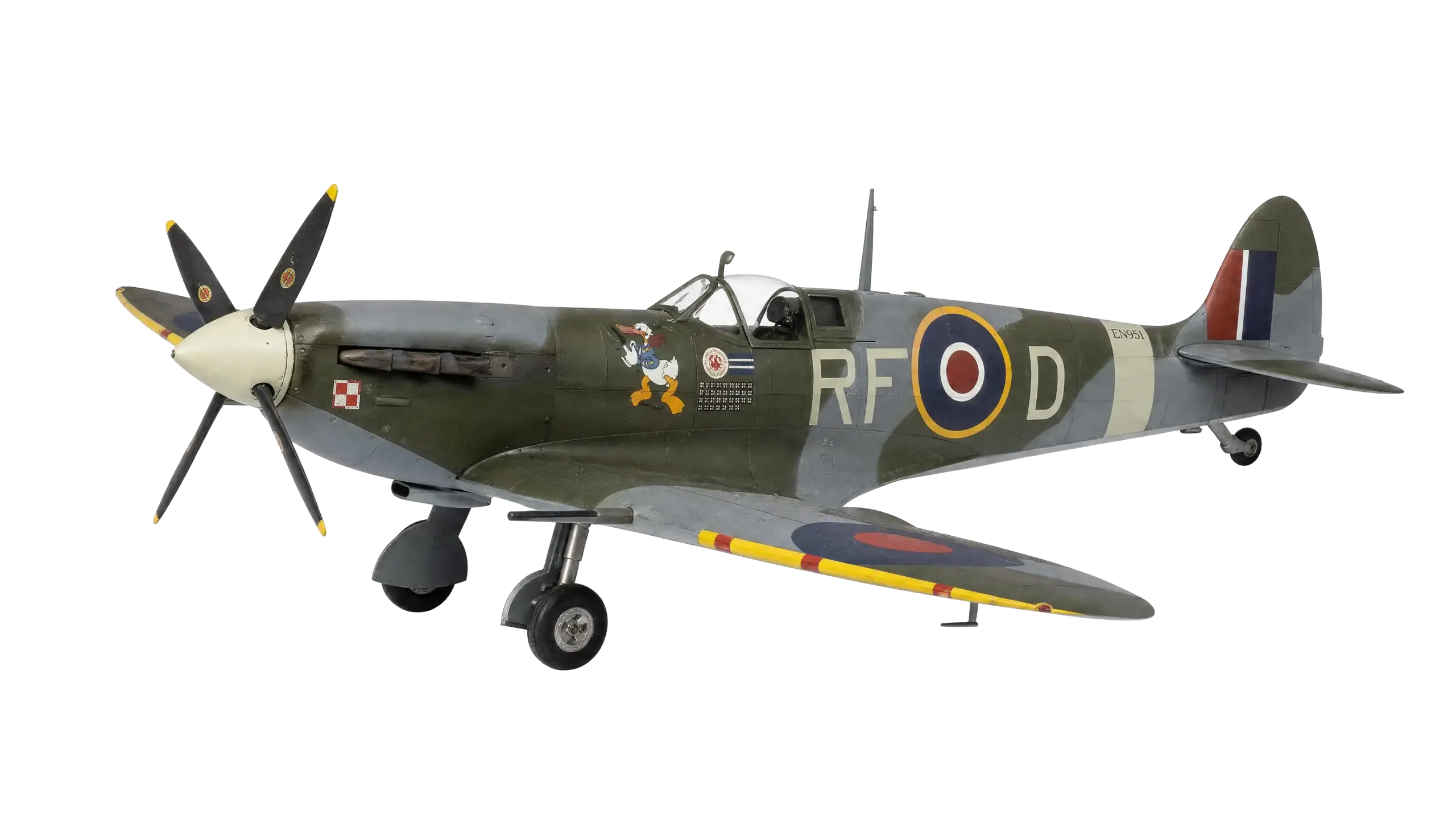
This project is developed as a faithful flying reproduction of the original airframe,
not a simplified Spitfire silhouette. The long Griffon nose, five-bladed propeller, elliptical wing,
radiator housings, cockpit profile, tail geometry, narrow retractable landing gear, and late-war fighter stance
are treated as essential structural elements of the real aircraft.
The model is designed around full functional mechanization of the airframe wherever
the original structure makes it meaningful: working control surfaces, retractable landing gear,
scale-correct flap movement, mechanically credible gear doors, radiator details, tailwheel geometry,
and carefully proportioned control-surface movement.
In advanced configurations, the onboard controller can support a Griffon-Spitfire flight profile:
measured throttle ramping, deliberate takeoff power management, synchronized landing-gear and flap sequences,
lighting functions, and timing that reflects the forceful character of a high-powered late-war interceptor.
The purpose is not to imitate a generic electric warbird, but to preserve the operational rhythm of a Mk XIV.
Custom Finish
Every Spitfire Mk XIV can be developed as a custom-finished individual aircraft.
A build may be based on a documented squadron machine, a specific serial number, late-war RAF camouflage,
tactical markings, personal details, operational weathering, exhaust traces, paint wear, invasion stripes,
or a carefully researched postwar restoration scheme.
The objective is not a generic RAF fighter with roundels. It is a historically credible individual aircraft
with a finish, surface depth, and visual identity that match the precision of a fully mechanized scale airframe.
The Spitfire Mk XIV should feel faster before it ever leaves the runway.
Its scale character comes from Griffon power, disciplined mechanics, elliptical-wing precision, and the unmistakable tension of a late-war British interceptor.
Wronsky Aeroworks Model
Every Wronsky Aeroworks model is individually finished by hand, receives its own serial number, and undergoes detailed quality inspection before shipment. Each aircraft is produced in limited numbers with an emphasis on historical accuracy, clean geometry, crisp surface detail, and premium presentation.