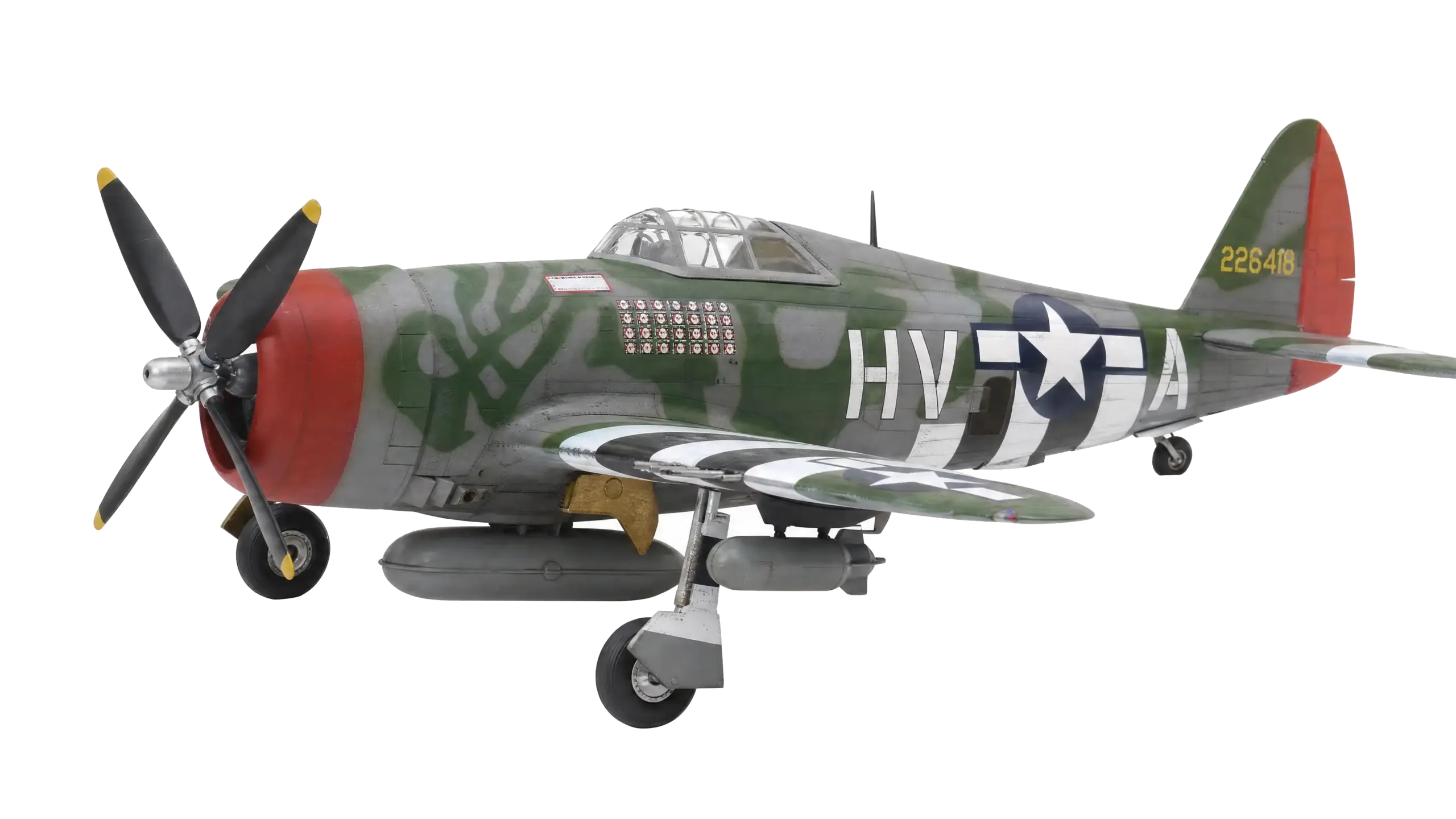
Republic P-47D Thunderbolt
Aircraft Collection
The Republic P-47D Thunderbolt was one of the largest and toughest single-engine fighters of World War II:
a high-altitude escort fighter built around brute power, turbocharged performance, and extraordinary combat durability.
Overview
The P-47 Thunderbolt was not built around elegance in the conventional sense.
It was built around survival, power, altitude, and firepower. Its huge radial engine, broad fuselage,
deep belly, large propeller, and heavy wing structure gave it a physical presence unlike almost any other
single-engine fighter of the war.
Pilots called it the Jug, a nickname usually connected to its large, rounded profile.
Yet the Thunderbolt was far more sophisticated than its size suggested. A turbo-supercharger system
installed deep inside the fuselage allowed the aircraft to retain strong performance at high altitude,
where escort fighters needed power most.
Eight .50 caliber Browning machine guns gave the P-47 enormous striking power. Combined with a tough airframe,
self-sealing fuel tanks, and a radial engine capable of absorbing damage, the Thunderbolt earned a reputation
for bringing pilots home after punishment that would have destroyed lighter aircraft.
Operational Use
The P-47 began its combat career as a high-altitude bomber escort over Europe. As fuel capacity increased,
it was able to accompany heavy bombers deeper into occupied territory and eventually into Germany itself.
It later became one of the most effective American fighter-bombers of the war. Thunderbolt pilots attacked
rail traffic, vehicles, airfields, supply columns, gun positions, bridges, and armored formations. Bomb racks,
rockets, and eight heavy machine guns turned the aircraft into a powerful low-level attack platform.
The P-47 served in Europe, the Mediterranean, the Pacific, and with several Allied air forces.
Its combination of ruggedness, speed in a dive, high-altitude capability, and heavy armament made it useful
in roles far beyond its original escort-fighter mission.
Historical Context
Designed by Alexander Kartveli, the P-47 emerged from a period when American fighter design
was rapidly moving toward more powerful engines, larger airframes, enclosed cockpits, and heavier armament.
Republic’s answer was extreme: instead of pursuing a lightweight fighter, the company built a machine around
the massive R-2800 Double Wasp and a complex turbo-supercharger installation.
The result was one of the defining American combat aircraft of World War II. The P-47 was expensive,
complicated, and heavy, but it gave the USAAF a fighter that could survive, climb, dive, carry ordnance,
and hit hard in an extraordinary range of conditions.
Notable Pilots
The P-47 is closely associated with pilots including Francis “Gabby” Gabreski,
Robert S. Johnson, Hubert “Hub” Zemke, and
Neel Kearby. Their combat records covered different units and theaters,
but together they helped establish the Thunderbolt’s reputation as a serious air-combat machine.
For historically grounded custom builds, aircraft from the 56th Fighter Group provide especially strong references:
personal nose art, invasion stripes, squadron colors, tactical codes, field-applied markings,
exhaust staining, chipped paint, and the hard-used look of fighters operating from wartime airfields.
Model Focus
This project is developed as a faithful flying reproduction of the original airframe,
not a generic American warbird silhouette. The large radial-engine cowling, broad propeller profile,
deep fuselage, wing-root geometry, turbocharger ducting, canopy shape, tail proportions,
and wide retractable landing gear are treated as essential parts of the aircraft’s engineering identity.
The model is designed around full functional mechanization of the airframe wherever
the original aircraft makes it meaningful: moving control surfaces, retractable main gear,
scale flap operation, mechanically credible gear doors, realistic turbocharger and cooling details,
and a carefully proportioned relationship between the radial engine, propeller, and fuselage.
In advanced configurations, the onboard controller can coordinate landing-gear sequences,
flap deployment, navigation lighting, radial-style throttle response, and scale-function timing.
The goal is not simply a powerful electric model. It is a Thunderbolt with the visual mass,
mechanical rhythm, and controlled aggression of the original fighter.
Custom Finish
Every P-47 can be developed as a custom-finished individual aircraft.
A build may be based on a documented fighter group, a specific pilot’s aircraft, invasion stripes,
squadron colors, tactical codes, theater camouflage, weathering, mission markings, oil staining,
and surface wear appropriate to a hard-operated wartime fighter.
The objective is not a factory-clean generic Jug. It is a historically credible aircraft with its own
visual story, custom surface finish, and detail level worthy of a fully mechanized scale airframe.
Historical markings are adapted with respect for destination-market requirements.
The P-47 should look powerful before it ever leaves the runway.
Its scale character comes from the radial engine, turbocharged bulk, wide landing gear, visible mechanics, and the unmistakable confidence of the American Thunderbolt.
Wronsky Aeroworks Model
Every Wronsky Aeroworks model is individually finished by hand, receives its own serial number, and undergoes detailed quality inspection before shipment. Each aircraft is produced in limited numbers with an emphasis on historical accuracy, clean geometry, crisp surface detail, and premium presentation.