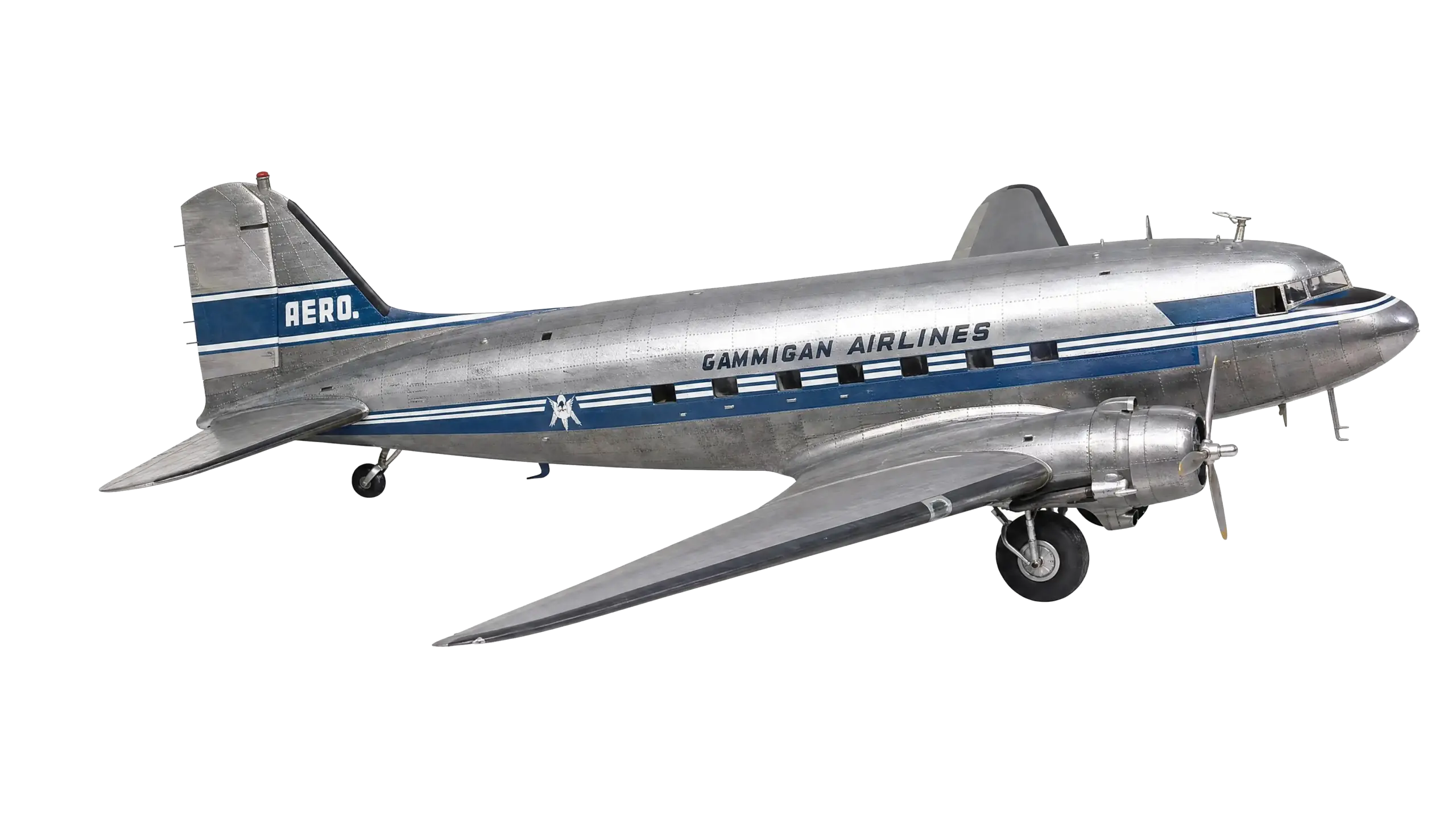
Douglas DC-3
Aircraft Collection
The Douglas DC-3 helped make long-distance passenger flying practical,
profitable, and genuinely comfortable for ordinary travelers.
Overview
The Douglas DC-3 was not simply another airliner of the 1930s.
It was the aircraft that proved passenger service could stand on its own without depending entirely
on mail subsidies. It carried enough people, flew far enough, and did it with a level of comfort
that changed what Americans expected from air travel.
Its proportions were almost perfect for its era: a low wing, two radial engines, retractable landing gear,
a deep passenger cabin, and a tailwheel stance that made the aircraft look substantial even when parked.
The DC-3 had the confidence of a serious transport without losing the visible mechanical character
of early American aviation.
It became an icon because it was capable without being complicated. The aircraft looked like it could cross
the country, carry a full cabin, land at a smaller airport, and continue working for decades afterward.
In many ways, it did exactly that.
Operational Use
American, United, TWA, Eastern, Delta, and numerous international airlines used the DC-3 to establish
reliable passenger routes across the United States and around the world. It became the backbone of airline
networks at a moment when commercial aviation was transforming from an expensive novelty into a realistic
form of transportation.
During World War II, military derivatives such as the C-47 Skytrain,
the Royal Air Force Dakota, and the U.S. Navy R4D carried troops,
cargo, wounded personnel, and airborne forces. The civilian DC-3 and military C-47 shared the same core
lineage, but the C-47 used a reinforced floor, large cargo door, and other military-specific modifications.
Historical Context
The DC-3 emerged from Douglas Aircraft Company’s earlier DC-1 and DC-2 designs, but it was the larger,
more capable DC-3 that changed aviation history. Its first commercial service began in 1936, and within only
a few years the type had become one of the defining aircraft of the global airline industry.
The design proved so adaptable that its story did not end with passenger service. Wartime production,
postwar cargo conversion, regional transport, aerial survey, forestry work, skydiving, and museum restoration
all kept the DC-3 family alive long after most aircraft of its generation had disappeared.
Model Focus
This project is developed as a faithful flying reproduction of the original airframe,
not simply a twin-engine transport silhouette. The low-wing proportions, radial-engine nacelles,
large spinners, deep fuselage, passenger windows, tailwheel stance, wing-root geometry, and classic DC-3
tail profile are treated as structural elements of the real aircraft.
The model is designed around full functional mechanization of the airframe wherever
the original design makes it meaningful: independent twin-engine operation, moving control surfaces,
scale flap deployment, retractable main landing gear, functional tailwheel steering, realistic gear-door movement,
navigation lighting, and mechanically credible propeller and nacelle detail.
In advanced configurations, the onboard controller can coordinate staged twin-engine startup behavior,
independent throttle response, landing-gear sequencing, flap movement, cabin and navigation lighting,
and scale-function timing. The aim is not a generic electric twin. It is to preserve the calm authority
and transport-aircraft rhythm of a real DC-3.
Custom Finish
The DC-3 offers exceptional possibilities for a custom-finished individual aircraft.
A build can be developed around a period airline livery, a real civil registration, polished-metal accents,
early American carrier colors, weathered cargo service markings, postwar charter schemes, or a historically distinct
military derivative configuration.
The objective is not a generic silver transport. It is a specific aircraft with believable history:
an airliner that appears ready for a cross-country passenger route, a cargo run into a remote field,
or a restored appearance at a classic American airshow.
The DC-3 should feel dependable before its wheels leave the ground.
Its scale character comes from twin-radial symmetry, transport-aircraft mechanics, a deep working fuselage, and the unmistakable confidence of an aviation original.
Wronsky Aeroworks Model
Every Wronsky Aeroworks model is individually finished by hand, receives its own serial number, and undergoes detailed quality inspection before shipment. Each aircraft is produced in limited numbers with an emphasis on historical accuracy, clean geometry, crisp surface detail, and premium presentation.