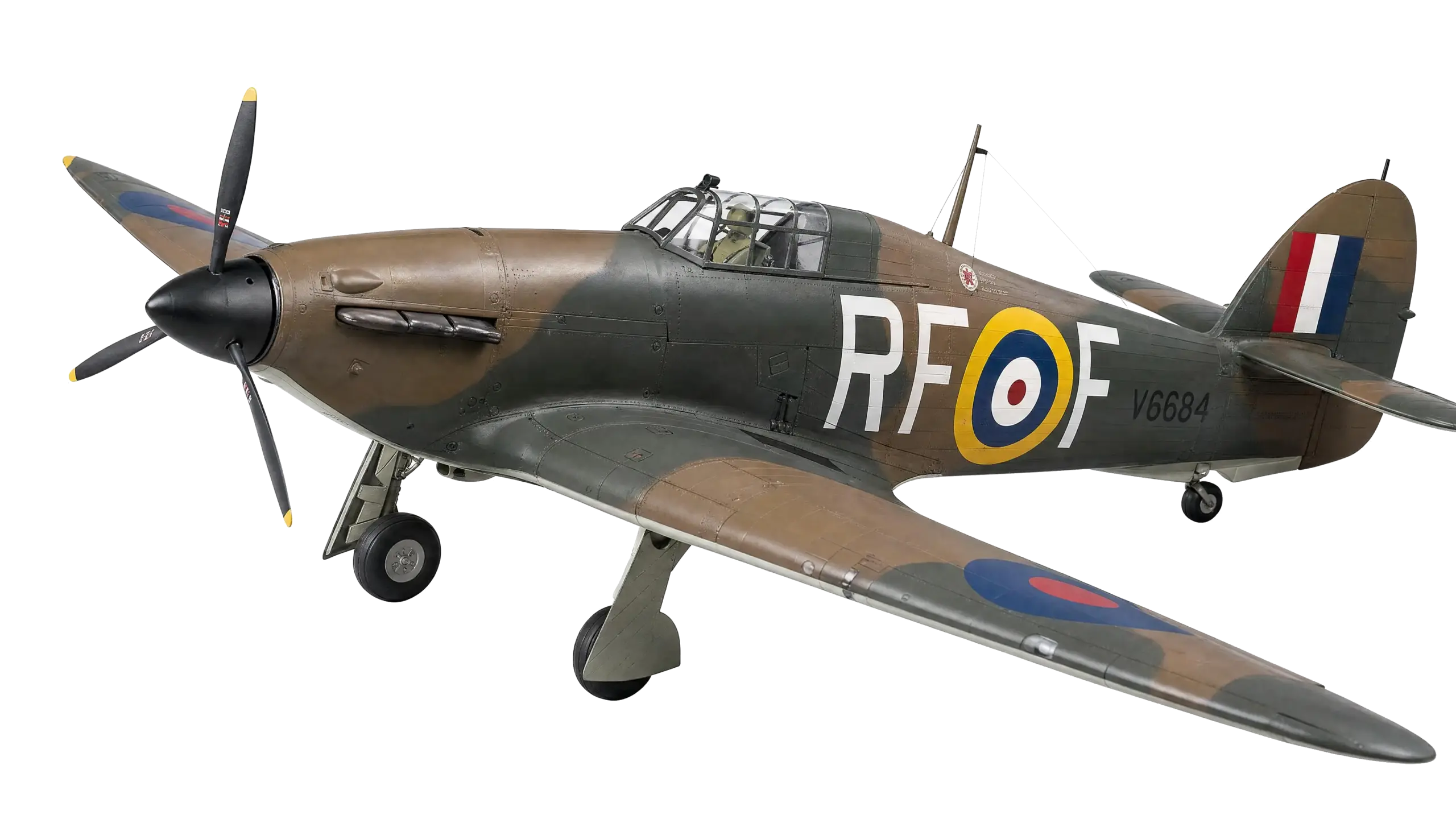
Hawker Hurricane Mk I
Aircraft Collection
The Hawker Hurricane Mk I was the fighter that gave Britain a practical,
hard-working answer to a rapidly escalating air war: stable, repairable, heavily armed, and built to fight in numbers.
Overview
The Hawker Hurricane Mk I was not the most glamorous British fighter of its generation.
It was, however, one of the most important. Its broad wing, sturdy fuselage, wide-track retractable landing gear,
deep radiator housing, and eight-gun armament created an aircraft that looked purposeful before the engine even started.
The Hurricane was designed around practical wartime realities. It combined newer monoplane performance with construction
methods that remained understandable to maintenance crews working under pressure. The result was a fighter that could absorb damage,
be repaired comparatively quickly, and return to service when Britain needed aircraft in the air as fast as possible.
Where the Spitfire is often remembered as the elegant symbol of the Battle of Britain, the Hurricane represented
something equally important: reliability, numbers, and operational endurance. It was the workhorse
that carried much of Fighter Command’s burden during the critical air battles of 1940.
Operational Use
The Hurricane served during the Battle of France, the Battle of Britain, the Mediterranean campaign,
North Africa, the Soviet Union, and the Far East. In 1940 it formed a major part of RAF Fighter Command,
meeting German bombers and fighters over southern England at a moment when the survival of Britain depended
on keeping operational squadrons in the air.
Hurricane squadrons were often directed toward bomber formations, where the aircraft’s concentrated eight-gun armament
could be especially effective. Its stable gun platform, durable structure, and predictable handling made it a serious
fighting aircraft even as newer, faster designs began to emerge.
Later versions expanded the Hurricane’s role into ground attack, convoy defense, naval operations,
tropical service, and tank-busting missions. But the Mk I remains the purest representation of the type:
a frontline fighter built for the desperate opening phase of the air war.
Historical Context
Designed by Sydney Camm, the Hurricane first flew in 1935 and entered RAF service in 1937.
It arrived during a moment of major technological transition, when open-cockpit biplanes were rapidly giving way
to enclosed monoplano fighters with retractable landing gear, more powerful engines, and much heavier armament.
The aircraft’s structure helped define its wartime identity. The Hurricane used a steel-tube fuselage,
fabric-covered rear sections, and a practical approach to construction that supported repair and production.
Later Mk I aircraft received improvements including metal-covered wings, armor protection, and constant-speed propellers.
More than a machine of the Battle of Britain, the Hurricane became one of the RAF’s most widely used wartime aircraft.
Its story is not about being the fastest fighter in the sky. It is about being present, dependable,
and operationally useful wherever the war demanded it.
Notable Pilots
The Hurricane Mk I is associated with pilots including Douglas Bader,
Tom Neil, Witold Urbanowicz, and
Josef František. Their combat experiences were different, but all became connected
to the aircraft during the RAF’s hard-fought defense of Britain in 1940.
The Hurricane also carries a strong Polish story. No. 303 Squadron flew Hurricanes during the Battle of Britain,
making aircraft from that unit especially meaningful references for historically grounded custom builds:
RAF camouflage, Polish checkerboards, squadron codes, weathering, exhaust staining, worn access panels,
and the visual language of an aircraft flown intensively from wartime grass fields.
Model Focus
This project is developed as a faithful flying reproduction of the original airframe,
not a generic early-war fighter silhouette. The broad wing, radiator housing, Merlin nose profile,
cockpit framing, fabric-and-metal surface character, tailwheel geometry, and wide retractable landing gear
are treated as defining structural parts of the Hurricane.
The model is designed around full functional mechanization of the airframe wherever the
original design makes it meaningful: working control surfaces, scale-correct flap movement, retractable landing gear,
realistic gear-door behavior, radiator detailing, authentic tailwheel movement, and carefully proportioned wing geometry.
In advanced configurations, the onboard controller can support a Hurricane-specific flight profile:
controlled throttle response, deliberate takeoff-power management, synchronized landing-gear and flap sequences,
lighting functions, and scale timing suited to a powerful Merlin-era interceptor rather than a generic electric model.
Custom Finish
Every Hurricane can be developed as a custom-finished individual aircraft.
A build may be based on a documented RAF squadron, a Battle of Britain machine, a No. 303 Squadron aircraft,
a Mediterranean scheme, a tactical code, a specific pilot, or a carefully researched restoration-inspired finish.
The objective is not a generic dark green fighter with roundels. It is a historically credible individual aircraft
with surface detail, operational wear, custom markings, and finish quality worthy of a fully mechanized scale airframe.
The Hurricane should look dependable before it ever leaves the ground.
Its scale character comes from wide-track mechanics, visible structure, broad-wing stability, and the practical confidence of Britain’s wartime workhorse.
Wronsky Aeroworks Model
Every Wronsky Aeroworks model is individually finished by hand, receives its own serial number, and undergoes detailed quality inspection before shipment. Each aircraft is produced in limited numbers with an emphasis on historical accuracy, clean geometry, crisp surface detail, and premium presentation.